Showing posts with label ballardian. Show all posts

Friday, September 21, 2018

Applied Ballardianism by Simon Sellars (book review)

An Augean non-place (Alice in the rabbit hole)

Applied Ballardianism by Simon Sellars is a huge novel, larger than its word count would suggest. 

It's an account of a man whose thoughts are ruled by the works of J G Ballard, the writer whose novels and essays explored the effects of changes in technology, environment and suburban development on human psychology. He encounters UFOs, thugs, strangely belligerent ferrymen, barflies, computer-game avatars, a dwarf on a bicycle, and much forbidding architecture. Several people are eager to give him drugs, one of whom is a doctor. His burning desire is to figure out how Ballard’s work ties this accelerating madness together before it all crashes to a halt.

Applied Ballardianism arrived in an ordinary, expected Amazon bubble wrap envelope, slipped under the gate. It had been loosely bagged with an order of Silverfish bait in a carton that had dented the corners of the pages. I’d ordered the baits because a population explosion of Silverfish is assailing the house. If you’re not sure what these are, they’re little silver robot-looking bugs that are to be found all along book shelves, chewing at pages and leaving ragged holes in the texts. They also favor living inside household picture frames, consuming the images and dying under the glass like self-mounting museum pieces.

A silverfish, yesterday


Applied Ballardianism's genre is described as ‘theory-fiction’, which was new to me. I had to dig for definitions. It’s a construction from philosopher and wordsmith Jean Baudrillard. DeBoer says of Baudrillard’s theory-fiction, “Theory must abandon production for seduction and revel in the ecstatic supersaturation of its own linguistic nature. Baudrillard does not have to theorize with the intention of affecting a 'reality,' but can let his theory stand as fiction or literature that persistently draws attention to its own lack of grounding.” In the book, Sellars points out the word ‘Baudrillard’ surrounds and subsumes the word ‘Ballard’.


(Picture by LH; index is not in book)


Theory-fiction is credited (by Wikipedia, and of all things, Urban Dictionary) as being pioneered by philosopher Nick Land, whose work has been described as speculative realism in which formalism and representation become continuous with respect to one another, wiping out the real object to which they ostensibly refer. “The collapse of the signifier/sign/signed triangle in semiotic theory into a duality of signifier and signed.”


This definition seems to me to be a case of having had too much to think. Just like little Jim Ballard in the movie of Ballard’s Empire of the Sun.

More simply, according to Wikipedia, Nick Land’s version ‘is noted for its unorthodox interspersion of philosophical theory with fiction, science, poetry, and performance art.’ In other words, it’s just theory – philosophy or literary theory – mixed with fiction. There’s a list of theory-fiction here, which seems to agree with Wikipedia’s definition, but even as I type that I realize I am getting caught in the Baudrillardian lobster pot of multiplying words and hoping it will help.

So, to recap, we have some theory-fiction, by Simon Sellars, which will either explain a theory by using fiction or will collapse the semiotic triangle into a duality, or both.

(Picture by LH; index is not in book)


Now I come to think of it, I’ve read theory-fiction of this type before. Valis, by Philip K Dick, which I’m not going to summarize here because we don’t have all day, Zen and the Art of Motorcycle Maintenance, by Robert Pirsig, and probably less well known and a surprise to Sellars, The Man Who Killed Mick Jagger, by Richard Littlejohn.

ZATAOMM is the writings of a man on a long motorcycle trip with his son. He remembers he used to be someone else, and his pre-breakdown self is still inside his mind as an alter ego. As the trip progresses, he remembers that his previous self, an adjunct professor, broke down from “thinking too hard” about the philosophical concept of Quality. He now champions a different way to work on the problem of Quality, rationality, which he illustrates and practices via motorcycle maintenance. His mind begins to heal. He even works out why he sometimes dreams his son is on the other side of a glass door- it’s an analog of the door between them in his old mental hospital.

TMWKMJ has stuck in my memory since the day I read it, in 1979. As I recall, it recounts the maturing of a philosophizing, unlovable failure as he does a Grand Tour of European Culture and frets constantly because the modern world refuses to live up to the glories of his beloved Medieval Art. A run-in with violent thugs does not help matters. Having been subjected to enough philosophy to harm himself, he has internalized Nietzsche. He’s different, the superman. He must clean up his civilization. He begins with the idea of killing Mick Jagger, onstage, at the Oakland Coliseum, and he ends there as well, as his jump to make the attempt is the last line of the book.

Applied Ballardianism follows an unnamed protagonist who is styled as ‘I’. I’m going to call him ‘Sellars’ as his life follows the broad outlines of the life of Simon Sellars, the author, with whom I’m acquainted on Facebook and elsewhere online. ‘Sellars’ was working in a warehouse in the nineties, an aficionado of the cyberculture of that time, with its transhumanism, piercing rituals, hippie boosterism and much-lauded white-hat hackers. Unimpressed by their promises of a bright future, he gravitates to the scene's more nihilist cyberpunk cellar. From his new perspective, he quickly comes to see the onrushing digital world as a “tsunami of data”. Convinced he has “Information Fatigue Syndrome”, he visits a doctor to see what can be done about it. “I’m a cyberwarrior,” he tells the doctor. “And my mind is going.” This is the first of many times ‘Sellars’ sees himself start to unravel – the scale against which he measures his mental health changes exponentially, so he’s mostly drifting around the low end of an increasingly mad world. The doctor gives him some pills, imprinted with the symbol of a dove, that have unexpectedly disorienting effects.


i-D magazine Devil Girl cover


Picking up one of the cyberculture glossies – i-D magazine, the issue with a devil-girl on the cover – he reads an interview with J G Ballard.  The writer is pictured making a sanpaku-eye gesture, challenging 'Sellars' to look more closely.

He decides to “risk it all” and read Ballard’s most famous, and infamous, work, Crash. Crash’s narrator is ‘James Ballard’, whom ‘Sellars’ describes as a “rough copy of the real Ballard, a flawed clone.” We’ll hear a lot more about ‘copies’, doubles and ‘clones’ later. This is the beginning of the end for poor ‘Sellars’. Crash “snaps” him. Head filled with theories about Ballard’s oeuvre, he enrolls in university and begins to study for a PhD in Ballardianism. When his tenuous connection with cyberpunk fails – when he learns they have embraced Billy Idol and yet have no room for him, "Sellars', at their S&M parties – he throws himself into drilling down into the source of Ballard’s apparent importance.


All this puts 'Sellars' in my bailiwick, since I had some similar experiences - I was at ACM Siggraph in 1993, when Billy Idol appeared at a party there to plug that album. That was either the year I had a press badge or the year before, I forget. On seeing what was on offer, I told my editor nothing of interest happened and I couldn't be bothered to write the article. (He did not object.)

An Augean non-place (from The Fly)


‘Sellars’’ life spins out of control. His lover repudiates him. Academia fails to hang on his every word. People keep offering him those pills with the dove imprint. UFOs are spotted. Street lights mysteriously go out when he walks by them. Almost everything that happens reminds him of a Ballard story. The few that don’t remind him of postmodern philosophers or movies. (If you have not read Ballard or Baudrillard, this is not a problem as Sellars describes each piece and how it pertains.) He gets a job as a travel writer, but everywhere he goes, he sees only the Ballardian surface which by now coats every aspect of reality. Hotels and airports, the "non-places" that aren’t truly anywhere? Marc AugĂ©, and Ballard. Dubai? Mostly Ballard, some Chris Marker. The concrete bunkers of the western Atlantic coast? Virilio, and a lot of Ballard. Back home to Australia? He gets himself his own Ballardian “hoodlum scientist” and moons after him in a very Ballardian way. He’s sure everything is connected. If only he could mentally shift things into another configuration, it would all come together and make sense.

(Picture by LH; index is not in book)


Applied Ballardianism, billed as a “memoir from a parallel universe”, is a mixtape, a series of samples set to a rhythm, a supercut. It’s autobiographical (and there’s nothing more standard than a professor writing about the colossal in-fights of academia – academic politics are so vicious precisely because the stakes are so small, as they say, and for a TA they’re smaller still), it’s science fiction, paranormal mystery, a critique of consumer society and a travelogue of post-modern theory.
It’s hyperreality, where fiction and reality are blended together seamlessly, both at the level of ‘Sellars’ and his wildly out of control imagination, and at the level of the reader observing Simon Sellars, the writer, extrude ‘Sellars’, his fictional double, his portal-mirror and his off-kilter double exposure.


Scalpel from Cronenberg's Dead Ringers


For more information on postmodern theoreticians, click here. For even more information, click there again.


(Note: The 'index' is not part of the book. It's from my notes. Picture selections are my own as well.)

Tuesday, October 25, 2016

Matris in Gremio: Ben Wheatley's High Rise (movie, 2016) (R)


I have some experience with the ostensible subject matter of High Rise, the tower blocks of the mid-1970s. I lived in the London Docklands in the late 70s to 80s, a fair proportion of that on the 11th floor. Once, desperate to get a place of my own, I’d visited a friend who lived in Balfron Tower, in Bow, the Erno Goldfinger Brutalist tower block that has been named as Ballard’s inspiration for the block in his 1975 novel High Rise. I remember taking the lift to the relevant floor in the service tower and then, when faced with walking along the connection to the main residential tower block, ending up crawling on my hands and knees, unable to face the view from the (enclosed) walkway. Needless to say, I didn’t take up my friend’s offer of his council flat (apartment), but when I found myself living on the 11th floor of a more normal block on Westferry Road on the Isle of Dogs, a few years later, I had not a trace of acrophobia. It appears to have been Erno-related anxiety. I lived in that tower block as Docklands went from a dumping ground for otherwise un-housables to an expensive gentrified waterfront area, and well recall the building of new, non-council (i.e. non-projects) towers with their differential sale prices – top-earning yuppies in multi-million pound penthouses, normal bankers in fractional-million pound lower floors. I left around the time the derelict Canary Wharf was beginning to be built up. It was an odd time to live in Docklands.  Gentrification, however, was several years after the book was published and the movie is set. Ballard a prophet? Perhaps.

My tower block last year, from Google Maps Street View


View of City of London from my tower block, 1980s

View of what was actually at the foot of my tower block, 1980s

Balfron Tower, picture ganked from this article

Now, the film. It's an R. I'm not sure why - there's a lot of violence and a few rude words in it, along with a little sex. A few of the rude words may make it into the review. The block in the movie is not like the dissected Goldfinger towers of London. It’s described as “like the distal phalanx of an index finger of an open hand”, but it looks to me more like a phallus with a bad case of chordee. There are five of them in various degrees of construction in the movie, all with that crooked top. It may be that the falling tip is ‘overarching’ rather than drooping but it’s hard to tell from internal movie clues.

The movie ostensibly follows Laing, who moves into the new tower block, attracted by its claim to supply all one may need from life, from living space, to gym, to pool, to onsite supermarkets. The new building has some shakeout problems, “settling” as the home-owners are told to think of it. The garbage chute clogs up. The power occasionally goes out. Our protagonist is a middle-class psychiatrist who has just bought an apartment on a middling floor. It has the lovely Brutalist feature of sloping naked concrete beams intruding into the living space, giving Laing a sudden impulse to paint all his belongings the same shade of grey. A straightforward reading of the film is that it tells the tale of a rebellion against the upper floors by the inhabitants of the cheap (but full utilities-paying) lower floors during an extended power cut, mediated by and observed by the middle-floor-dwelling Laing. In the darkness the food-deprived inhabitants blockade their floors, restrict access to outsiders, raid for supplies and, after the supermarkets are emptied, begin to eat their pets. On the surface, this is a typical dystopian movie plot. Who will become the leader of the block? How will he protect his women? And why don't they escape/call the police/go live with their mum?

It’s a little challenging to keep track of all the characters in the film. Even with its extended running time, not everyone gets fleshed out (or their flesh taken off). In addition to Laing, there is a junior psychiatrist Munrow, the designer of the block who is often just called The Architect, his enforcer Simmons, his wife, his mistress, his wife's mistress, Laing's women, and the lower-floors leader, the impulsive and violent Wilder, who "in real life" makes TV documentaries. There is a man who is always on the telly, and several more. They have many affairs, many wives and many children.

You can’t say Wheatley and subtle in the same sentence but the stand-out vignettes include a supermarket check-out conveyor belt converted to a torture-treadmill like the one Snake Plissken is chained to in Escape from LA, and the They Live-esque fist-fight over Laing’s can of grey paint that gave me quite a laugh. It also features a soothing amount of Tom Hiddleston-flesh, ABBA’s SOS performed by a string quartet, Portishead and soundtrack-man Clint Mansell as the running theme, Surrealist treasures in the penthouse, blink-and-you-miss-it allusions to other films and some very pointed, quick fire dialogue. One that stands out is the documentary maker’s wife casually throwing away the line, “he’s lost his focus” and later there’s an extended riff on the whole movie, beginning with the architect saying of one character, “she has quite a tight c*nt” and segueing into a description of his apartment owners having “fitted themselves tightly into their slots” (in society), with Laing immediately referring this back to the structure of the building “slots designed by you”. “I conceived this building,” the architect says as in the background women talk about babies’ bottles. “I offered a means of escape to a new life,” he continues, just as a new baby is born.

I don’t see any reason why this movie was so widely panned when it has more in common with The Matrix than its usual comparator, Snowpiercer. The latter was a one-dimensional allegory with all High Rise’s problems and none of its solutions. If I had to think of a similar film, I’d point to Lindsay Anderson’s If…. and Britannia Hospital. I think High Rise has a wider range of deeper motifs than those, however. In other words, High Rise deserves cult status, but that’s not something one can predict.

I’ve seen the film reviewed as being in some way about a typical seventies fear of high rise living. Just no. Should we also assume that Ballard had a fright about the bits of grass that grow between interchange lanes in complex highways such as freeways (Concrete Island) or was worried that iguanas might colonize London (The Drowned World) or had been in a funk that the angle between two walls might not have a happy ending (the Ambit ad)? There’s obviously allegory going on somewhere. What might it be?

Let’s get the obvious one out of the way. The movie makes no secret that it’s ‘about’ the British class structure. If you take the phrase ‘social climber’ and dial the setting to ‘tower block’ you get the basic structure automatically. The film constantly refers to high life, lower orders, Marie Antoinette and power failures (i.e. failures of the powers that be). Laing buys an inexpensive Riesling from the supermarket and attempts to enter a party on the upper floors from whence he is summarily ejected, for wearing the wrong clothes and for being a cheap bastard. The people on the lower floors have lots of loud children, while the upper floors’ dwellers are famous and childless, and the uppermost of all, The Architect – whose name is Royal – has a formal rooftop garden, a horse, goats that his gauzily-dressed wife herds with a Louis XVI-era shepherd’s crook, and a dozen pampered dogs. The chief of the lower floors is called, natch, Wilder. He has a pregnant wife, several children and a poster of Che Guevara. He leads the rebellion against the upper floors.

Our man Laing belongs to neither caste, but is ideally placed as a go-between.

The social order allegory also explains one of people’s biggest moans about the movie: why none of the inhabitants try to leave the building as it breaks down. Wheatley bafflingly leaves the explanation to a voice-over at the very end, long after these people will have given up on the film as unrealistic. We hear Margaret Thatcher’s voice over the radio, “There is only one economic system in the world, and that is capitalism. The difference lies in whether the capital is in the hands of the State or whether the greater part of it is in the hands of people outside of State control. Where there is State capitalism there will never be political freedom.” You must choose one, because there is no other system – there is no ‘outside’ to which to go. And given that you can only choose one, you should choose free enterprise, because freedom. In this analogy, the inhabitants have chosen free enterprise, and Laing, who is chewing on the last roast dog leg and thinking about setting up a private practice, is clearly all for freedom.  (You might argue that the TV personality guy left the block every day for work, but of course as his final scene showed, a man on the telly who is at work is equally in the apartments, inside their TVs, and cannot be said to have left the tower block.)

There’s a second metaphor that overlays the political one. It’s signaled by an early shot of a young medical doctor reading “Psychopathology of Everyday Life” by Sigmund Freud. The building itself is described in the film as a diagram of a psychic event. (This sounded very Ballardian, almost out of place, so I wonder if it’s a phrase from the book that wandered into the script.) The main character is not only a psychiatrist, he’s called R Laing, calling rather obviously to mind RD Laing, the psychiatrist who promulgated the theory that a psychotic episode is a result of a mind being placed in a lose-lose situation, a double bind, and the symptoms of which are an attempt to communicate the untenable situation. The building itself, with its bony ramifications, is a skull. We’re shown several skulls for comparison purposes. At one point, during a medical school dissection, we see the skin literally peeled back from a skull and the doctor hammer-and-chisel his way inside. Wheatley is not a subtle visual director. Laing, us, is the ego. Royal, The Architect, is the superego and the aggressive, rebellious, rapacious Wilder is the Id. The inciting incident leading to Laing's psychotic break is his very unprofessional treatment of a patient that leads to harm, and the film is on this level detailing Laing’s subsequent psychoanalysis. He checks out his own internal state and decides whether he needs the recommended treatment or not.

On yet a third level, the Architect is simply a god. Above everyone’s heads, dressed in Morgan-Freeman-God-White clothes, he’s described as the first to arrive in the building and the last to leave, one of the characteristics of Almighty God. “Alpha es et O”, as the hymn In Dulce Jubilo puts it, the alpha and the omega, “I am the first and the last”. He pores over his architectural plans like The Ancient of Days, Urizen, the demiurge of reason, laws and caste-based conventional society in Blake's mythology. He’s a Gnostic God, trapped in this reality, and his creation is, as always, flawed. (But Laing is not our Christ.) He is a Royal who uses a walking stick, the crippled Fisher King. As such, his wound has made him sterile and rendered his land barren and unable to support its people. He is also an alchemist– he says he designed the building as a “crucible for change” but he either put one too many or one too few "elements" in it. (He later comes to terms with his resulting rather leaden “gold”, as Ballard characters tend to do.)

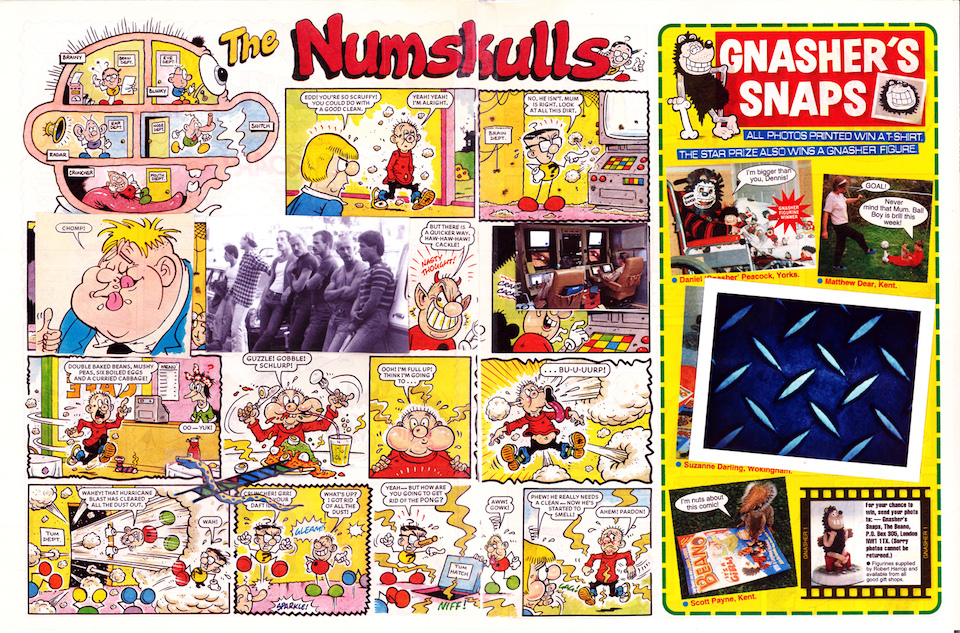
The fourth metaphor I’m not sure was in the novel. The building, it seems, is built along the lines of Ken Reid’s famous and hilarious Nervs from Smash! comic, as well as Malcolm Judge’s earlier Numskulls from Beezer comic. The Numskulls were a collection of idiots who manned the skull of an unfortunate person, “Our Man”, operating his ears, eyes and brain, a little like the small people inside the girl in Inside Out, but less PC. The Nervs, despite their name, were little internal people who operated the entire body and brain of an equally unfortunate person, “Fatty". For example, they control the stomach acid pipeline. If you put the Nervs and the Numskulls together, you get the inhabitants of High Rise. This is not exactly a lofty literary theory, but I for one grew up reading these comics and many people my age, or with children my age, did, and it’s a visualization of the self that is certainly easy to, well, internalize. And let's face it, for every one British person who's read Baudrillard or Houellebecq there must be a dozen who read The Numskulls (and another dozen who've seen Inside Out).

We see this metaphor early on, where the blocked garbage chute (and man do I remember the blocked garbage chutes in the tower block where I lived) symbolizes not only a block in the internal workings of the body politic but also a more earthy block of the type that your grandma worries about, insisting you eat more fiber and drink castor oil to make you regular again. Much later, Lang describes himself as a blood cell, able to travel the arteries of the body by walking through the corridors. The implication is the other inhabitants perform the other functions. Rather than a beckoning finger, or a crooked phallus, the building with its rows of balconies is a human body with a series of compartments, as in the famous Dali paintings.

And the stinger is, the body, the block, appears to me to be female, as Dali depicted her. There are chronological and textual juxtapositions between descriptions of the building and a woman giving birth, for example. (See above for some dialogue.) Wilder ultimately asks Royal why he stole his wife, why he hides behind women’s skirts. He tells the architect to “sit there and think about what you have done”, like a kindergarten teacher. The architect is described as a midwife. There are maenads, nurturers, nymphs at the pool. The whole incident is described as “a children’s party got out of hand”. Despite the ego, superego and id being male-presenting, the block is clearly female. I think of this as scriptwriter Amy Jump’s little joke.

This is going to reward multiple rewatchings.
 

Friday, January 24, 2014

The news is very Ballardian these days

The news has been very Ballardian recently.

First, we have the news that Hispaniola, a huge tropical island, is sinking - not under the sea, but into a lake of freshwater that's mysteriously swelling.  The lake in the Dominican Republic (one half of the island of Hispaniola, along with Haiti) is rising and swallowing towns and farms. Dead palms stand in the shallows of Lago Enriquillo which inexorably rises.  It seems like the classic Ballard scenario.


However, despite the mysterious water source, the beaches, the iguanas, the tropical palms and the drowned buildings, it doesn't quite have that J G Ballard swing. The Crystal World was set in a slowly-petrifying jungle; The Day of Creation tracked the source of a mysteriously-appearing African river, but The Drowned World with its carefully watching iguanas was set in a sunken, tropical London.

So, despite that fact that the replacement housing looks fearfully like the concrete blocks that litter atomic atolls in Ballard's fiction, I'll reluctantly scratch that one.

But how about this?

It appears that a cruise liner broke its mooring years ago, and is now afloat on the oceans, threatening to run aground, crewed only by cannibal rats. The Lyubov Orlova, named, in quite a Ballardian fashion, after a film starlet, was being towed to the Dominican Republic (I sense a pattern here) to be broken when it came loose.  Apparently there have been some false alarms before, but currently Ireland is thought to be within the sights of the rat privateers.


Picture from the Guardian article, attributed to Serge Sauvage, FlckrVision

Now if the ship had been filled with English cruise passengers, ranging from upper middle class men luxuriating in balconied staterooms to lower middle class aspirants in windowless below-deck cabins, eventually abandoned by their captain and crew and left to fend for themselves with the cannibal rats, I think that would have made quite a blockbuster latterday Ballard novel.

Wednesday, February 24, 2010

Satellite cuneiform

From the unlikely combination of the Daily Mail and the JG Ballard mailing list, here's a picture from Google Maps of a warplane graveyard.


It looks like cuneiform. A proclamation in some strange language only satellites can see and understand.

Sunday, April 19, 2009

RIP J G Ballard

We all knew he was sick, but of course you never expect it to happen.

I'd read a few Ballard pieces in Mike Moorcock's New Worlds when I was a kid. They were a struggle at the time, since I was more interested in rocket ships than inner space at that age, but I read them nevertheless. I read The Drowned World, The Drought, The Crystal World and The Wind From Nowhere as a pre-teen. Much easier going. It wasn't until my mother stuck Crash back into the library bag with "I'm not reading any more of that pornography!" that I realized there was more to Ballard than a strangely angled Cosy Catastrophe. (Perhaps I'd forgotten all those New Worlds shorts already.) Then I read Crash - and everything I could about him. the Re/Search issue on him is a gem.

It evidently worked - I won a competition in the semi-prozine Interzone for a Ballard pastiche, a condensed novel (less than a page long), a novelization of the movie Alien as filmed by David Cronenberg. Sad to say I haven't kept up with the newer (post eighties) output as well I could have. Ballard and Dick are my favorite authors and now neither of them are around any more. Sad indeed, but as some of my friends are saying, his death could be his big break. Looking forward to those American re-issues of his work. But still sad. RIP.


Guardian obituary by David Pringle (who adds, "Inevitably, the paper has hacked it about a bit, but not too severely. A couple of sentences no longer read as well as they should -- and one idiocy has been inserted: JGB was interviewed in Shanghai in 1991 for a TV programme broadcast in 2004. (No! It was shown on BBC 2 in 1991 -- and then repeated on BBC 4 in 2004.)"
BBC obituary
More info at Ballardian.

Sunday, March 02, 2008

Lost America Night Photography

When I first came to the American west, in 1989, some of the first things to catch my eye were the ruins. It was hard for me to grasp that a place which was virtually empty of people until 1930* could have ruins. American styles of this type, from 1930s to 1965-ish were completely foreign to me. I'd seen a couple of episodes of The Jetsons and I used to watch an MTV program that was set in a 1950s basement, but apart from that, this architecture and decoration seemed simply bizarre. I'd never seen them lived in or worked in, so to see them abandoned didn't really mean anything. It was as if they had only been built by aliens with only one purpose - to be abandoned.

Then, on a more deliberate search one year, I started seeing the Space Age ones. After that, I think I understood a lot more of J. G. Ballard's writing.


(Photo Credit to Lost America.
Reduced in size from the original)

The Lost America website has long exposure night photography of abandoned western ruins. They range from the gas stations of the Okie migration to the airfields and abandoned airframes of the old Cold War bases. Some of them are breathtaking. I spent a long time looking around this site and wishing I'd taken photos and then I read the descriptions about kneeling on broken glass for eight minute exposures and was glad I hadn't. Very interesting site.


*Recently devoid of people, I mean.

Sunday, September 30, 2007

Memories of the Space Age

Simon Sellars at Ballardian has a piece on 20th Century Castles - the repurposing of Cold War missile Silos as living spaces.

Minimal Concrete City for Sale: Serious Interested Parties Only!

I'm mentioned as the inhabitant most likely to be seen prowling the underground corridors with my home-made alien hybrids shambling in the air conditioning ducts above me.

Photo Sharing and Video Hosting at Photobucket

Let's move on to much sunnier things, shall we? The innocent days of World War II, when men were men (with pipes and moustaches called Squiffy) and the Safety of the Free World (tm) was ensured by cerebral geniuses ensconced in much less robust castles such as this one, a hut at Bletchley Park.

Monday, April 16, 2007

Radio On (Chris Petit, 1980) DVD

Sound and Vision

Chris Petit's 1980 movie Radio On got its DVD release earlier this month. (Spoilers below.)

Radio On documents a road trip of Robert, an affectless man in the 'Winter of Discontent' world of pre-Thatcher Britain in 1979. His brother has committed suicide in Bristol. Robert recently received a parcel from him for his birthday, which he reviews before he starts on his trip. In it, there are three Kraftwerk tapes. He puts one in his car tape/radio, but never seems to get to like it. One track is 'Radio Activity'; it's semi-appropriate. Robert is a DJ in a factory, though not really a 'radio' DJ, employed to play requests, which he reads out but ignores, playing his favorites instead. The workers don't mind; in fact they don't seem to notice. Perhaps they can't hear over the machinery. He plays "Sweet Gene Vincent."

He leaves his unpleasant lover and bare flat in Camden, driving via the Westway and the M4 motorway out to Bristol to check his brother's house. The car's radio is on, playing anthemic pop from the late seventies. He hears a news snippet about a porn bust, which may be a clue. We never find out. He meets a squaddie in a pub, gives him a lift, but abandons him at Silbury Hill when he finds out he's crazed with PTSD from a tour in Northern Ireland. He plays primitive video games at a motorway service station. He is roughed up by a woman for occupying a location that interferes with her pool shot. At a petrol station he encounters the outside world, the American Dream, personified here by Sting. They sing Three Steps to Heaven together, but America is inaccessible; we see a clipping about the automobile accident near Bristol that killed Eddie Cochran and crippled Gene Vincent. Robert meets two German girls. One of them hates men. "There's no word for that in English," he tells the other one. "There's only a word for a woman-hater." He finds out his brother had a live in girlfriend. She doesn't want to talk. He and the German girl visit her mother by the sea. They talk in German about the granddaughter. He can't understand them.

He reviews his clues, projecting pictures against the angle between two walls. Bondage photos and tourist photos intermingled. He stands in the image, his face incorporated into the scenery as a twist of geometry, looking keenly into the projected face of his brother. Nothing passes between them. He drives his Austin Rover to a quarry, and parks on the very edge of the vertical face, Kraftwerk's Ohm Sweet Ohm thrumming out over the void gouged in the bleak winter landscape. Too late he remembers that the ancient car requires a hand crank to start. He's too close to the edge to use the starting handle. The motor car can go neither forward nor back.

He takes the train back to Camden.


Radio On doesn't have to mean anything. As you watch it, you infer relationships based on your familiarity with the language of film. Your inferences may or may not be correct; it doesn't really matter. The film itself is beautiful, shot in black and white (the DVD is un-restored and not as luminous-silver as it should be) each shot carefully composed. Each scene is held for much longer than is natural in a movie. Where a current movie may have four to fourteen camera angles set up for each minute and literally dozens of cuts between those angles in a minute, Radio On has two or three angles for a scene and cuts every one or two minutes. The effect is like being led through an art gallery by a docent who moves you from one piece of artwork to the next at his own pace. I didn't like it when I first saw it in the cinema, and I think that's why; the feeling of being held hostage, restricted by someone else's sense of time, annoyed me. I'm more tolerant now.

The camera angles chosen are unusual. Here's a few: A long shot from a tower block window, following the car over a motorway junction. A shot from a flyover looking at a hotel where separate windows frame two characters whom we know to be in the same room, but are now explicitly shown to be in different frames of reference. A plane coming in to land, slightly leading the car we're following. A visual poem as we watch Robert downshift the car as he comes to a road junction. The famous scene of the thick, soapy rollermops flailing at the windows as he goes through the car wash.

The sound is perfectly ambient. The film leads us in by fading the music played over the credits from the normal sound of in-home DVD music to the tinny, enclosed sound of music played over a car radio as we transition to a scene inside his car. It's a common opening, and yet it signals very strongly how the sound is going to be treated throughout. You can hear every space that the film depicts; make out its shape and the materials that it comprises. Jukeboxes, seabirds, the compressed-air whoomph! of cars passing in the opposite direction, all sound natural and live.

The music soundtrack is justly famous. It starts over the credits with David Bowie's "Heroes"/Helden, a song that is equal parts wildly inspiring and suicidally despairing. Its effect seems to come from the song's completely non-English sensibility. Instead of hanging on in quiet desperation, the song directs the listener to struggle, because we can beat them, though victory will be just for one day. Half in German, it's a perfect match for Radio On, which is the same. The rest is a roster of seventies music: Wreckless Eric, Lene Lovitch, Ian Dury, Devo.

The film has one oral pun: "Why do the English like to be at the seaside?" the German girl asks. "It's the last resort," Robert replies.


(All images are from the DVD)

LinkWithin

Blog Widget by LinkWithin
I sometimes mention a product on this blog, and I give a URL to Amazon or similar sites. Just to reassure you, I don't get paid to advertise anything here and I don't get any money from your clicks. Everything I say here is because I feel like saying it.