Despite my best judgment I ended up watching KAOS on Netflix. The premise seems to be, "What if O Brother Where Art Thou met American Gods and had a threesome with a high school book of Greek Myths?
Which sounds fine, I guess. The main problem - or attraction - is its use of a device I call Stolen Valor. (I'm aware that calling something Stolen Valor that isn't Stolen Valor is in itself Stolen Valor, but I can't think of another name.) This Stolen Valor - Mark II, perhaps - is bringing in legendary slices of pop music at chosen moments to substitute for an Eyeball Kick the visuals can't provide. I can understand why it's done, but the calculatedness takes me out of the moment.
The very first scene of the series is double-underlined and italicized by the use of the stonking introductory riff of Dire Strait's "Money For Nothing." Whatever you may think of Dire Straits and their legacy, there's no doubt that guitar sound makes the heart beat faster. What was weirder is the director kept it going when the vocals started, yea unto the line "Look at them yo-yos." Slight loss of dignity there, I thought.
One after another the hits kept coming, with a high point for me being a few bars of The Kills' "Future Starts Slow," another track where the guitar sounds as if it's about ready to burst its skin and swoop down to eat your face.
By the third of fourth episode I'd gotten used to it, and then they used just a smidgen of Dawn Penn's 1993 reggae classic "You Don't Love Me (No No No)."
It was so good to hear it again, only to have it fade out after the 30-second-long scene was over.
The song goes all the way back to Bo Diddley's "She's Fine, She's Mine" of 1955. Which may be the best version, IMHO.
But the version I grew up on - from the iconic Immediate Anthology of British Blues Volume 2 - is "You Don't Love Me" by Tony TS McPhee. With me it's always the guitar sound.
When I was a lass, What's Up Tiger Lily was the epitome of this sort of thing. Wait, not the epitome - the only example. Taking a whole visual text, and re-imagining it with a new, absurdist, soundtrack
Nowadays the kids - in this case, Bad Lip Reading - hit it out of the park on a regular basis.
This one takes Stranger Things and makes it suffer a sea change into Something Richer and Stranger Things. It takes on a new life, with new characters, new motivations and faint echoes of meaning.
A surrealist riot.
The songs are:
Glitter Job's Ice God of Hungary
And Seagulls' Stop It Now
Both of which are Bad Lip Reading again, just doing to songs what they do to movies.
I'm back from LA. I forgot to post the last photographs, so here they are.
When I say I'm "back from LA", I live sixty miles away. To many folks, that's *in* LA and I'm one of them Califurnians with the Hollywood and the city with no 'there' there. Before I moved to the US, when I wrote for advice on living here to a Californian writer, lo these 30 years ago, he said he lived in SF and LA was "the eighth circle of hell". Or maybe seventh or tenth but you get the picture. Anyway, sixty miles is a lot. I live in a town of (according to the city limits sign) 35,000-ish people, which is smaller than the town I was born in. It has open spaces, lots of horses, and a community website filled with people who have lost cats and people who are berating them for not taking care of their pets properly.
Person 1: Help! I've lost me cat.
Person 2: You should take more care of your cat.
Person 3: Oh no I've lost muh cat plz find him
Person 4: You useless excuse for a human, how dare you lose your cat!
Person 5: Ma dog's gone missing.
Person 6: Fuck you, subpar dog owner! Don't you know there's coyotes about!
Person 3: I found mah cat,,,thanks every bod
Person 7: Don't lose him again you feckless maroon.
Person 2: I saw a coyote or maybe it was your dog at the end of the street last night.
Person 7: Here's 65 numbers for the police, animal control, agricultural extension, mayor, sheriff, vector control and dogcatcher. I've phoned them all about the rabid coyote attacking dogs at the end of your street and we should all call constantly until something is done about the coyote menace that's causing us to cower in fear in our own homes like prisoners in a world gone mad.
Person 1: I've lost me cat again. Come back little kitty I love you.
Person 2: You should be guillotined and your head displayed on a stake you vicious pet-losing animal. Your kind is worse than Hitler.
And so forth. The topic changed abruptly yesterday because someone saw a girl at one of the communal swimming pools wearing a thong, so she wrote in to tell us that we should stop destroying our children's lives by forcing them to see women's bodies at the pool, in Southern California. Not surprisingly there's been a bit of a backlashette about her opinion. Right now it's up there with the electric company's eminent domain grab of some of our prime real estate, the reactions to the guy who wants to build a farmers market on a plot of unimproved mud near the town center which will increase traffic and no doubt cause poltergeists and werewolves to break out all over town, and the guy who wants to house the town's homeless people in the empty toilet-flush factory that closed down a couple of years ago. Lost cats are temporarily put aside for such momentous matters as these.
Anyway, it's sixty miles from LA. I took a taxi down from LAX once, several years ago, and the taxi driver got increasingly agitated as we entered Orange County, and became almost alarmed as we got to south county. Eventually, he blurted: "Why do you live all the way down here?!"
Silly me, I had thought that LAX was "all the way up there" and where I lived was "right here". Glad he put me straight.
Angels Flight on 3rd Street, where we left off
While I was in LA, you may recall, I visited the 3rd Street funicular, Angels Flight. A couple of streets down from there is the Grand Central Market, and next to that, the very much photographed and filmed Bradbury Building.
(c) Google
I know the Bradbury Building best from Blade Runner. At the time of filming it was run-down, and Ridley Scott added creepiness and running rainwater to make it look even more desolate. It's been completely refurbished and looks stunning today. I don't know what the Grand Central Market looked like when Ridley Scott was scouting locations back there in the early eighties, but right now, it looks exactly like the LA street scenes in the movie, except for less Tik and Tok moving through the crowds. The woman who said, "Not fish scale - snake scale!" is definitely there, as is Taffy Lewis and his scummy burlesque. (At least in spirit.)
Bradbury Building entrance
Bradbury Building's superb iconic look
STB in the Bradbury hallway
Bradbury entrance
Bradbury Building's cage elevator
The building opposite the Bradbury
You may recognize the architectural details at the top of this theater from Blade Runner as well. It's across a full-size street from the Bradbury Building, so I don't think Roy Batty could have jumped it in the rain, however superior he was to us humans.
Inside the market, there's every food known to man.
It can be hard finding a spot to sit. I'm not surprised Deckard had to wait in the rain until he was beckoned over by the stall-holder.
No, I didn't use the photo of the Pupuseria with you in it, woman who looked aghast that I was taking photos. I might use it later, but I'll blur you out, promise.
Thai guy on the boil at the Sticky Rice shop. I had a great red curry, and STB had a wonderful sea-food soup and a chicken something-or-other. It was too good for us to keep notes.
Thai guy's pots, a lovely still life vista in the bustle of the market.
After that, it was back down south, to whyever the heck we live so far southsville and our exciting neighborhood website. I'll miss you, tenth circle of hell!
When It Might Get Loud came out in 2009, I was just getting into Jack White’s music and at the peak of a rediscovered Led Zeppelin fanaticism. I loved the hell out of the idea of the film. Thesis: take three guitarists and examine the role of rock guitar in music, and what drives the players to learn and excel at it – starring Jimmy Page, Jack White and The Edge.
The premiere was in LA and when I phoned up for tickets, they said there were two premieres. I asked what the difference was, and she didn’t tell me the truth, which is how come I went to the second premiere that didn’t have Jimmy Page and Jack White in attendance. But never mind! I saw it another two or three times in the cinema, and then bought the DVD. I gushed about it several times on my blog, and other bloggers – cooler heads, one might say – did try to tell me it wasn’t very good, but I wasn’t having any of it.
I re-watched it just now. There’s things I still love about it. Jack’s laconic gunslinger outsider shtick, Jimmy’s palpable excitement at listening to Link Wray’s Rumble and his enthusiasm with the other players; Edge’s self-deprecation and brief Wanderer-of-the-Wasteland episode ending when the looming tangle of trees suddenly resolves into perfect rows with clear paths between them; the cows listening to Jack’s Diddly Bow; the slide guitar jam near the end; the White Stripes performing for a room full of puzzled Chelsea Pensioners. And although the three men seem to be mostly there because they were the three who answered the phone, rather than anyone’s idea of a broad selection, they settle into their roles as Jack (heart), Edge (head) and Jimmy (groin).
The cooler heads were right, however. The exercise was flawed in numerous ways. Neither producer Thomas Tull nor director Davis Guggenheim demonstrate an understanding of the guitar nor are they able to pull together a cohesive account of the electric guitar or its place in rock. The narrative used is a three-act drama, which means that at the top of the second act, someone had to have a crisis, reach rock bottom and be forced to develop new strengths to overcome adversity and ultimately triumph. This is a really strange thing to have in the middle of a factual film that is not a biography. It’s shoehorned in by bending poor old self-effacing Edge’s story, having him go into exile to learn songwriting skills. Which he does, but the sought-for emotional catharsis is blunted by its artificiality. As a more concrete example of a flaw, Jimmy’s first electric guitar is labeled onscreen a ‘Stratocaster’ even though it’s a Grazioso, and Jimmy was one of the least likely rock musicians to be seen with a Strat at any point in his career.
More obviously (and loudly) two of the three guitarists refuse to stick with the script. Jack’s first love is the drums, and he’s portrayed as switching to guitar mostly because his upholsterer boss Brian Muldoon already played drums and he wanted to jam. Apart from a fair amount of drumming, the bulk of Jack’s music in the film is thumped out on piano, so Guggenheim must have been overjoyed to get hold of the footage of him bleeding for his art all over a guitar pickguard. Jimmy loves guitars – literally – but spends a lot of time talking about producing music (mostly drum sounds) and plays a lovely mandolin bit. At least he can tell his spooky story about the guitar “intervention” when his first guitar turned up mysteriously in his house just as he became interested in music. Edge sticks to guitar, but his style – very simple riffs compounded into lacy ruffles by echo, delay and other effects – means that the film spends most of its time marveling at his equipment and following his guitar tech around.
The ’summit’, where all three guitarists meet for the first time, with their equipment set up around them, is evidently supposed to be a climax. In the event, all three seem a little shy, and you watch The Edge, ever eager to please, trying to keep the conversation going by asking Jimmy questions but aware that he needs to avoid the minefield of disallowed inquiries that have tripped up many a professional journalist and gotten them yelled at by an irate Page. (He steps in it with the Kinks question, but manages to get out with both feet intact.) They demonstrate one of their famous riffs each, teach it to the others, and then join in on the ultimate song of the movie. It’s… The Weight, that old chestnut, played on acoustic guitars, and there’s nothing about it that you wouldn’t see at any house party where three or more of your friends brought or found an acoustic instrument and downed sufficient beers to have a loose jam.
It’s worth watching, because we care about the people and what they have accomplished, but as a movie, alas, it’s strictly third-tier.
I have some experience with the ostensible subject matter of High Rise, the tower blocks of the mid-1970s. I lived in the London Docklands in the late 70s to 80s, a fair proportion of that on the 11th floor. Once, desperate to get a place of my own, I’d visited a friend who lived in Balfron Tower, in Bow, the Erno Goldfinger Brutalist tower block that has been named as Ballard’s inspiration for the block in his 1975 novel High Rise. I remember taking the lift to the relevant floor in the service tower and then, when faced with walking along the connection to the main residential tower block, ending up crawling on my hands and knees, unable to face the view from the (enclosed) walkway. Needless to say, I didn’t take up my friend’s offer of his council flat (apartment), but when I found myself living on the 11th floor of a more normal block on Westferry Road on the Isle of Dogs, a few years later, I had not a trace of acrophobia. It appears to have been Erno-related anxiety. I lived in that tower block as Docklands went from a dumping ground for otherwise un-housables to an expensive gentrified waterfront area, and well recall the building of new, non-council (i.e. non-projects) towers with their differential sale prices – top-earning yuppies in multi-million pound penthouses, normal bankers in fractional-million pound lower floors. I left around the time the derelict Canary Wharf was beginning to be built up. It was an odd time to live in Docklands. Gentrification, however, was several years after the book was published and the movie is set. Ballard a prophet? Perhaps.
My tower block last year, from Google Maps Street View
View of City of London from my tower block, 1980s
View of what was actually at the foot of my tower block, 1980s
Now, the film. It's an R. I'm not sure why - there's a lot of violence and a few rude words in it, along with a little sex. A few of the rude words may make it into the review. The block in the movie is not like the dissected Goldfinger towers of London. It’s described as “like the distal phalanx of an index finger of an open hand”, but it looks to me more like a phallus with a bad case of chordee. There are five of them in various degrees of construction in the movie, all with that crooked top. It may be that the falling tip is ‘overarching’ rather than drooping but it’s hard to tell from internal movie clues.
The movie ostensibly follows Laing, who moves into the new tower block, attracted by its claim to supply all one may need from life, from living space, to gym, to pool, to onsite supermarkets. The new building has some shakeout problems, “settling” as the home-owners are told to think of it. The garbage chute clogs up. The power occasionally goes out. Our protagonist is a middle-class psychiatrist who has just bought an apartment on a middling floor. It has the lovely Brutalist feature of sloping naked concrete beams intruding into the living space, giving Laing a sudden impulse to paint all his belongings the same shade of grey. A straightforward reading of the film is that it tells the tale of a rebellion against the upper floors by the inhabitants of the cheap (but full utilities-paying) lower floors during an extended power cut, mediated by and observed by the middle-floor-dwelling Laing. In the darkness the food-deprived inhabitants blockade their floors, restrict access to outsiders, raid for supplies and, after the supermarkets are emptied, begin to eat their pets. On the surface, this is a typical dystopian movie plot. Who will become the leader of the block? How will he protect his women? And why don't they escape/call the police/go live with their mum?
It’s a little challenging to keep track of all the characters in the film. Even with its extended running time, not everyone gets fleshed out (or their flesh taken off). In addition to Laing, there is a junior psychiatrist Munrow, the designer of the block who is often just called The Architect, his enforcer Simmons, his wife, his mistress, his wife's mistress, Laing's women, and the lower-floors leader, the impulsive and violent Wilder, who "in real life" makes TV documentaries. There is a man who is always on the telly, and several more. They have many affairs, many wives and many children.
You can’t say Wheatley and subtle in the same sentence but the stand-out vignettes include a supermarket check-out conveyor belt converted to a torture-treadmill like the one Snake Plissken is chained to in Escape from LA, and the They Live-esque fist-fight over Laing’s can of grey paint that gave me quite a laugh. It also features a soothing amount of Tom Hiddleston-flesh, ABBA’s SOS performed by a string quartet, Portishead and soundtrack-man Clint Mansell as the running theme, Surrealist treasures in the penthouse, blink-and-you-miss-it allusions to other films and some very pointed, quick fire dialogue. One that stands out is the documentary maker’s wife casually throwing away the line, “he’s lost his focus” and later there’s an extended riff on the whole movie, beginning with the architect saying of one character, “she has quite a tight c*nt” and segueing into a description of his apartment owners having “fitted themselves tightly into their slots” (in society), with Laing immediately referring this back to the structure of the building “slots designed by you”. “I conceived this building,” the architect says as in the background women talk about babies’ bottles. “I offered a means of escape to a new life,” he continues, just as a new baby is born.
I don’t see any reason why this movie was so widely panned when it has more in common with The Matrix than its usual comparator, Snowpiercer. The latter was a one-dimensional allegory with all High Rise’s problems and none of its solutions. If I had to think of a similar film, I’d point to Lindsay Anderson’s If…. and Britannia Hospital. I think High Rise has a wider range of deeper motifs than those, however. In other words, High Rise deserves cult status, but that’s not something one can predict.
I’ve seen the film reviewed as being in some way about a typical seventies fear of high rise living. Just no. Should we also assume that Ballard had a fright about the bits of grass that grow between interchange lanes in complex highways such as freeways (Concrete Island) or was worried that iguanas might colonize London (The Drowned World) or had been in a funk that the angle between two walls might not have a happy ending (the Ambit ad)? There’s obviously allegory going on somewhere. What might it be?
Let’s get the obvious one out of the way. The movie makes no secret that it’s ‘about’ the British class structure. If you take the phrase ‘social climber’ and dial the setting to ‘tower block’ you get the basic structure automatically. The film constantly refers to high life, lower orders, Marie Antoinette and power failures (i.e. failures of the powers that be). Laing buys an inexpensive Riesling from the supermarket and attempts to enter a party on the upper floors from whence he is summarily ejected, for wearing the wrong clothes and for being a cheap bastard. The people on the lower floors have lots of loud children, while the upper floors’ dwellers are famous and childless, and the uppermost of all, The Architect – whose name is Royal – has a formal rooftop garden, a horse, goats that his gauzily-dressed wife herds with a Louis XVI-era shepherd’s crook, and a dozen pampered dogs. The chief of the lower floors is called, natch, Wilder. He has a pregnant wife, several children and a poster of Che Guevara. He leads the rebellion against the upper floors.
Our man Laing belongs to neither caste, but is ideally placed as a go-between.
The social order allegory also explains one of people’s biggest moans about the movie: why none of the inhabitants try to leave the building as it breaks down. Wheatley bafflingly leaves the explanation to a voice-over at the very end, long after these people will have given up on the film as unrealistic. We hear Margaret Thatcher’s voice over the radio, “There is only one economic system in the world, and that is capitalism. The difference lies in whether the capital is in the hands of the State or whether the greater part of it is in the hands of people outside of State control. Where there is State capitalism there will never be political freedom.” You must choose one, because there is no other system – there is no ‘outside’ to which to go. And given that you can only choose one, you should choose free enterprise, because freedom. In this analogy, the inhabitants have chosen free enterprise, and Laing, who is chewing on the last roast dog leg and thinking about setting up a private practice, is clearly all for freedom. (You might argue that the TV personality guy left the block every day for work, but of course as his final scene showed, a man on the telly who is at work is equally in the apartments, inside their TVs, and cannot be said to have left the tower block.)
There’s a second metaphor that overlays the political one. It’s signaled by an early shot of a young medical doctor reading “Psychopathology of Everyday Life” by Sigmund Freud. The building itself is described in the film as a diagram of a psychic event. (This sounded very Ballardian, almost out of place, so I wonder if it’s a phrase from the book that wandered into the script.) The main character is not only a psychiatrist, he’s called R Laing, calling rather obviously to mind RD Laing, the psychiatrist who promulgated the theory that a psychotic episode is a result of a mind being placed in a lose-lose situation, a double bind, and the symptoms of which are an attempt to communicate the untenable situation. The building itself, with its bony ramifications, is a skull. We’re shown several skulls for comparison purposes. At one point, during a medical school dissection, we see the skin literally peeled back from a skull and the doctor hammer-and-chisel his way inside. Wheatley is not a subtle visual director. Laing, us, is the ego. Royal, The Architect, is the superego and the aggressive, rebellious, rapacious Wilder is the Id. The inciting incident leading to Laing's psychotic break is his very unprofessional treatment of a patient that leads to harm, and the film is on this level detailing Laing’s subsequent psychoanalysis. He checks out his own internal state and decides whether he needs the recommended treatment or not.
On yet a third level, the Architect is simply a god. Above everyone’s heads, dressed in Morgan-Freeman-God-White clothes, he’s described as the first to arrive in the building and the last to leave, one of the characteristics of Almighty God. “Alpha es et O”, as the hymn In Dulce Jubilo puts it, the alpha and the omega, “I am the first and the last”. He pores over his architectural plans like The Ancient of Days, Urizen, the demiurge of reason, laws and caste-based conventional society in Blake's mythology. He’s a Gnostic God, trapped in this reality, and his creation is, as always, flawed. (But Laing is not our Christ.) He is a Royal who uses a walking stick, the crippled Fisher King. As such, his wound has made him sterile and rendered his land barren and unable to support its people. He is also an alchemist– he says he designed the building as a “crucible for change” but he either put one too many or one too few "elements" in it. (He later comes to terms with his resulting rather leaden “gold”, as Ballard characters tend to do.)
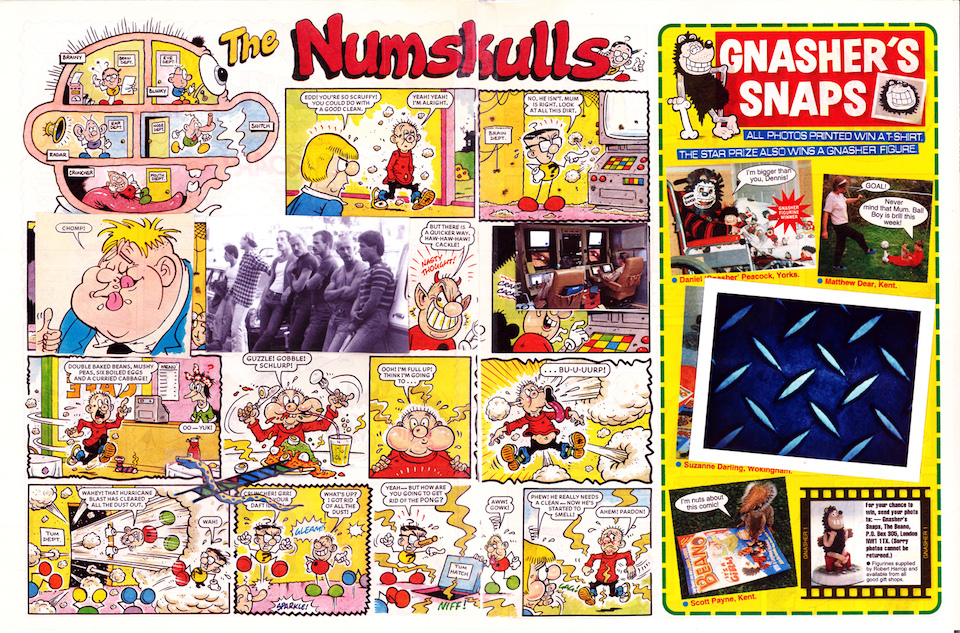
The fourth metaphor I’m not sure was in the novel. The building, it seems, is built along the lines of Ken Reid’s famous and hilarious Nervs from Smash! comic, as well as Malcolm Judge’s earlier Numskulls from Beezer comic. The Numskulls were a collection of idiots who manned the skull of an unfortunate person, “Our Man”, operating his ears, eyes and brain, a little like the small people inside the girl in Inside Out, but less PC. The Nervs, despite their name, were little internal people who operated the entire body and brain of an equally unfortunate person, “Fatty". For example, they control the stomach acid pipeline. If you put the Nervs and the Numskulls together, you get the inhabitants of High Rise. This is not exactly a lofty literary theory, but I for one grew up reading these comics and many people my age, or with children my age, did, and it’s a visualization of the self that is certainly easy to, well, internalize. And let's face it, for every one British person who's read Baudrillard or Houellebecq there must be a dozen who read The Numskulls (and another dozen who've seen Inside Out).
We see this metaphor early on, where the blocked garbage chute (and man do I remember the blocked garbage chutes in the tower block where I lived) symbolizes not only a block in the internal workings of the body politic but also a more earthy block of the type that your grandma worries about, insisting you eat more fiber and drink castor oil to make you regular again. Much later, Lang describes himself as a blood cell, able to travel the arteries of the body by walking through the corridors. The implication is the other inhabitants perform the other functions. Rather than a beckoning finger, or a crooked phallus, the building with its rows of balconies is a human body with a series of compartments, as in the famous Dali paintings.
And the stinger is, the body, the block, appears to me to be female, as Dali depicted her. There are chronological and textual juxtapositions between descriptions of the building and a woman giving birth, for example. (See above for some dialogue.) Wilder ultimately asks Royal why he stole his wife, why he hides behind women’s skirts. He tells the architect to “sit there and think about what you have done”, like a kindergarten teacher. The architect is described as a midwife. There are maenads, nurturers, nymphs at the pool. The whole incident is described as “a children’s party got out of hand”. Despite the ego, superego and id being male-presenting, the block is clearly female. I think of this as scriptwriter Amy Jump’s little joke.
Well, this is a hell of a theory. I used to hear all the Star Wars theories because I was on all the Star Wars theorizers' groups - but they are on Yahoo, and nobody goes there any more. (And not because it's too crowded.) So I came to Star Wars Ring Theory a little late.
You have to read it to really get the full impact of it, and it's 8 chapters long. I had to put it aside until I had an hour to read it, and even so I was getting punchy by the end and will have to read it again. But in a nutshell, he says that the prequels match the original series almost scene by scene, but not in a straightforward order. They form a ring, with the middle two inverted against each other. (It's called a chiasmus, which I'm familiar with from genetics - and it's fascinatingly so!) All those points where you think, hang on, hasn't someone else had a hand chopped off? Or, wait, is that the third time somebody's had a bad feeling about this? Or, didn't the last one open on a shot of a giant space vehicle approaching a planet from above, not below? And so on, and so on... They all fit together in a complex pattern, which he explains and illustrates with screen shots that make you wonder why you didn't think of this yourself.
One of my theories (what is mine) is every sufficiently large text is like the Bible, by which I mean that if you have a big enough corpus - Lord of the Rings, or Shakespeare, or Harry Potter - there is enough STUFF in there to make any random theory sound good because you can always find something that matches your thesis. I mean, I’ve read Shakespeare and the Goddess of Complete Being. I’ve read The White Goddess. I’ve read the Golden Bough. I started reading this in the same light, but he managed to convince me that there’s a single path through all of the films that makes sense as a ring/crossing over structure.
One sticking point for me was the discussion of good versus evil in the Star Wars universe as I'd gotten used to thinking of evil as a privation of good, a la St. Augustine, rather than a thing in itself. This theory seems to involve evil as a separate and equal force in the...er, Force. But if so, why does bringing balance to the Force involve the death of ALL the Sith but only SOME of the Jedi? That was always my sticking point with it, but he brings out several quotes from Lucas that not only support this view but actually state it in so many words. Yeah, I have to read it again. What do you think?
Today is the 600th anniversary of the Battle of Agincourt.
Kenneth Branagh and the legendary Brian Blessed rouse the ragged band of Englishmen to victory against the French.
Or Laurence Olivier, in a production that looks like it takes place in Disneyland, giving you little hope for the speech until Olivier, natch, pulls it off spectacularly.
I’m a bit late catching up with the 2013 Jim Jarmusch movie
Only Lovers Left Alive, but now that I’ve found it, it’s replaced my perennial
go-to romantic film Velvet Goldmine as the standard for films about eternal
lovers.
Ex-rock star Adam – he’s 500, but looks 30 – and the older Eve
– 3000, who looks somewhere between 40 and 2500 – are married but live
separately. Eve lives in Tangier, surrounded by piles upon piles of books,
where she can regularly meet her friend Kit Marlowe, who has settled in this historically literary
Moroccan city to ‘scratch out’ more plays and live with his current protégé,
Bilal. Adam lives in a Detroit Victorian
home, in a part of the city that has returned to nature. He lives in
America’s musical heartland, but his only neighbors are coyotes and the
occasional skunk.
Adam and Eve. To his credit, the filmmaker seems to realize that's an old fiction chestnut and goes beyond.
He’s a musician, and a determinedly analog one. The film opens with him relaxing with a lute
and his home is a paradise of reel-to-reels, wave-generators, tube amplifiers
and record players stacked up to the ceilings. He puts on the 45 of Wanda Jackson’s Funnel of
Love and we see that he and Eve have a psychic connection; from Tangier she can
tell he is sinking into ennui. It’s happened before. He despises zombies (humans) and their lack
of imagination, their non-acceptance of their own brilliant scientists, their lack
of ecological stewardship and the creeping, but unexplained ‘contamination’
that’s driven the vampires away from most supplies of human blood. (All three get their fixes from
hospital supplies of nice, clean O negative. Adam disguises himself as a ‘doctor’ – called Dr Faust
first, Dr Caligari the second time we see him - to infiltrate the hospital. Marlowe also obtains his and Eve's blood from a hospital. He doesn’t say how, but it’s hinted that all
things are available, in Tangier.)
Wanda Jackson. At first I thought it must be the Cramps version, but no, it's the 45 played at 33.
Eve calls Adam on her iPhone – her Apple, get it? – and Adam
answers on his old fashioned telephone handset with a cord, which he hooks up
to a cathode ray tube TV in order to Skype with her. She agrees to come see him, though travel,
even at night, is debilitating for their kind.
Meanwhile, Ian, his eager but gormless roadie/hanger on, brings him some goodies he’s scored:
a 1959 Supro (Adam sights along its neck to check for straightness like a pro), a “weird” Hagstrom, a Gretsch Chet Atkins 6120 with double-cutaway
and an early sixties Silvertone with the amp built into the guitar case. We get our first joke: As Adam respectfully looks over the Gretsch,
he mentions he saw Eddie Cochran play one of those...but it had been modified - the front pickup was a Gibson P-90. “You saw
Eddie Cochran play?” Ian asks incredulously. Cochran died in 1960. “Yeah,” Adam
replies, thinking quickly, “On YouTube.”
There’s no chance, of course, that Adam watches YouTube. There are a lot of jokes, all delivered so
deadpan that at first I didn’t realize how funny the movie is.
Eve comes over, and while he’s out picking up more blood, she
discovers he has a revolver with a single wooden bullet. Distraught, she tries to bring him out of his existential
malaise and they go for a drive, at night, obviously, through deserted Detroit.
The vacant lots, the faded glory, the stately procession of sights – the Michigan
Theater, the Packard plant - all build the feeling of long lives flowing
towards some sort of enforced change.
Hastening this, Eve’s “little sister” – (“Is she a blood relative?” “Well,
blood was involved.”), an apparently Millennial (she can’t be much more than 85),
vacuous, LA-dwelling bundle of energy, unsophistication and raw need blasts
into their lives (without even waiting to be invited over the threshold!),
wrecks everything and is ultimately unceremoniously thrown out. Adam and Eve
flee to Tangier, where they find Marlowe is sick from contaminated blood, though
he manages to summon the energy for one more dig at Shakespeare. Marlowe wrote
all his plays, of course.
Eve, Adam, Little Sister Ava and gormless Ian.
Drained from travel, without a supply of clean blood, they
listen to a Lebanese singer in a local café and contemplate their options. Adam finds time for another bon mot – no, he doesn’t
wish fame on the singer; she’s too good for that.
Starving, they sit on a bench as the cock crows. A pair of lovers walk by and embrace by a
wall. Adam and Eve can drink the couple’s blood or die when the sun comes up.
They make their choice, and the film fades to black.
Tom Hiddleston and Tilda Swinton are perfect for this film. He’s dark,
snake-hipped, high-cheekboned and a perfect high-register RP English speaker. He
handles humor, particularly where the younger sister is concerned, with
understated physical action. Swinton is blonde to the point of translucency,
with eyes the size of saucers, a mane of hair uncombed since about 360 BCE and
a cut-glass upper class accent. They
flawlessly portray lovers who have been together so long they don’t need to be
in close contact, and who have their undying love of art and science in common.
Other reviews seem to think of them as hipsters –
effortlessly cool. I didn’t see it that way. True, they were into your favorite
artist before he was popular, but that’s because they’re over 500 years old.
They knew Shakespeare. Adam remembers Byron as a bit of an ass. I saw their eclectic tastes as having brewed
slowly. One trusted way to play electric guitar, lute and oud well is to
practice. And if you practice for a few hundred years you’re going to be very good. If you’ve read everybody in every language, more than once, your taste in
authors will be wide-ranging. And yes,
they name-drop Jack White, a hipster fave, but I got the impression that’s
because Jack is one of them – they were excited to drive by his old house, but
note neither of them suggests finding his current house for a visit, just as
they keep away from ‘the others’.
Ultimately I see
the movie as a meditation on love, on art, but also on the phenomenon of
middle-aged people trying to come to terms with the changes in their city, the
world, the newfangled fashions and technology, and above all the lack of artistic sophistication that (the film suggests) characterizes the
Youth of Today.
Just for youngsters, i.e. anyone under thirty-five, here is a clip from Star Wars Episode IV: A New Hope, showing that Han shot first, and indeed was the only one to shoot, because he hit Greedo, obviously, and there was no return fire. (Thanks to uploader Daniel M Kobayashi.)
Whenever this one comes up, there's always a few people who don't care who shot first. They don't care that Greedo (in the Special Editions) missed at point blank range, and they don't care that Han waited for him to shoot first, a non-survival trait that really seems out of character for him as we first meet him.
As far as I'm concerned, Han not only did, but must have, shot first because he thinks only of himself - which he continues to do for some time. That's why he's an interesting character. When he starts thinking of others, and even helping other people for free, that's when you know the character has grown.
I'm not surprised to see this - 'pneumonic' for 'mnemonic' - as the people at work all pronounced it that way. (In a health care setting, and for all I know elsewhere, people have to learn keyboard shortcuts for lengthy technical terms, and the IT word for these short cuts is 'mnemonics'.)
I pronounce the p-one nyooooMONick and the mn-one nimMONick, but at the lab, both were noooMONick. That was in So Cal. The writer of the page imaged below is from London, so maybe I'm just wrong and they're both the first one.
Anyway, since it is a medical term, a story about Johnny Pneumonic would be pretty interesting. Johnny Mnemonic was about a data courier, Johnny, who has to transport double his standard 160 gigabytes of data in his brain implant to a customer in order to be given a cure for his nerve disease, whereupon Japanese gangsters get into the act. Mnemonic is from the word for the Greek personification of memory, the Titan Mnemosyne. It means to aid the memory, in particular a sequence of letters or images that help you remember. It was originally a short story by William Gibson, and made into a movie starring Keanu Reeves which I quite liked, although it was roundly panned.
'Pneumonic' just means 'pertaining to the lungs' originally from pneuma, which can either mean vital spark or breath of life, or just breath, or air, for short, and eventually refers to a 'lung'. (Not to be confused with pneumatic, which means something filled with or operated by compressed air, unless you're reading Brave New World, in which case it means bootylicious, except when describing the chairs.)
The most frequent use of the word pneumonic is in Pneumonic Plague. This is caused by the same bacterium as Black Plague or Bubonic Plague, but instead of infecting the lymphatic system (and causing it to come up in lumps, or buboes) it infects the lungs. Because it can be coughed out by the infected and inhaled by those around, it is far more infectious than flea-spread Black Plague and more virulent. At least until antibiotics were developed, it had a kill rate of close to 100%. As antibiotics fail over the next couple of decades, it could make a comeback.
If Johnny Pneumonic were to be hired to carry airborne plague across the globe, it would make a fine short story. (As 12 Monkeys already did, in fact.) You could tell Johnny he'd been infected with the cure for cancer. He'd never know the difference, at least until it was too late.
I'd like to review Mad Max: Fury Road, but I can't. It's only been out a couple of days and most of the things I'm excited about would be spoilers.
All I can say at this time is: I loved it. It is Mad Max. It's not like it was with similarly many-years-late reboot Phantom Menace - which was oh, yeah, I'm briefly excited about this but after seeing it I have to cop to severely lowered expectations. On the contrary, it takes Mad Max: Road Warrior and doubles everything about it, without betraying or undermining any of it. Nobody's mystic union with the universe is ploddingly revealed to be something to do with their SMA-20 blood test here.
I'd like a whole movie about those Terry Gilliam-type things who lived in the swamp. I want to know how the masses lived in Immortan Joe's world. I want to learn more about the mountain bikers who controlled the pass. I'd love to hear more about the old ladies who evidently had little problem, with, how shall I put this, with disposing of the bodies of those they kill in an ecologically sound and calorifically fulfilling manner. And the bad guys' pawns - the put-upon War Boys - might use those they catch alive as unwilling blood donors, but they're not unsalvageable monsters either. I want to know more about the seeds, about the baby, and about Imperatrix (not going to say Imperator) Furiosa's journey.
But what I got was a story that hinted at all of these things while charging forward inexorably. The bulk of the movie, as I'm sure you know, is a car chase. It's the ultimate car chase, as big, heavy and kinetic as any sequence of vehicles can be. You forget that there is such a thing as ground, as characters can not access it and have to get used to jumping from moving vehicle to moving vehicle in the deadly convoy. Killing, repairing, or even clinging to the hood to blow mouthfuls of fuel directly into the engine air intakes in order to max the revs, are all done at speed.
You may have heard that this is a "feminist" film. If that means women and men get equal shots at heroism, sure. It also has four damsels in distress - if feminism worries you, concentrate on their plight instead. They totally are in distress.
When I first saw The Road Warrior, or Mad Max II as it was then, in theaters, I wanted to live there. The whole world just seemed right. I'm much older now and would obviously prefer it if everybody would just get off my lawn but in Fury Road George Miller put in a biker gang of women at least my age who didn't give Fuck One, and that's inspiring.
I Netflixed the movie Frank (Dir. Lenny Abrahamson 2014) on streaming video.
I was interested in it because I thought it was about Frank Sidebottom (who was played by Chris Sievey), a Northern English comedian who wore a large papier mache head on stage, and whose jokes and routines were based around gentle northern humor. I missed out on all that, and Sievey sadly passed away before any of his slight fame could wash up over here in these great USAs of America.
It isn't based on Frank Sidebottom, I learned, when I started watching and the guy with the gaint round papier mache head had an American, as opposed to Cheshire, accent.
I rapidly looked it up and apparently it's based on an idea about Frank Sidebottom, from Jon Ronson, who wrote The Men Who Stare At Goats and is not the same person as Mark Ronson, who is a musician who makes all those records feat. Somebody Else. Despite not being Mark Ronson, Jon Ronson was once a musician in Frank Sidebottom's band, which is how he got the idea for a movie.
He explains himself in this Guardian write up; that he'd discussed the possibility of a film with Chris Sievey before he died, and had decided to write something about Outsider Artists in general rather than risk damaging the Frank Sidebottom, er, legend.
The movie begins, as in Ronson's real life, with "Ron" - played by someone who looks like one of the Weasley twins if the Weasley twins had been geeks - getting an impromptu gig with an unpronounceable band (the Soronprfbs) headed up ...heh heh... by a man in a giant cartoon papier mache head, which he never takes off. Not even in the shower. Ron is shanghaied into spending a year in a remote house in Ireland "rehearsing" for an album - the rehearsals bearing a strong similarity to the cult-abuse sessions held by Captain Beefheart for Trout Mask Replica - and eventually touring. The band take an instant dislike to Ron and want to kill him. Ron, for his part, is a starry-eyed musician who wants to make it big with his own compositions. He is hampered by his complete lack of talent.
At first (once I'd worked out this wasn't Frank Sidebottom we were following) I thought the band, and especially Frank, were a kind of figment of Ron's imagination, or at least just mythic figures, helpers and obstacles on his classic hero's journey to fame and and fortune. After a while, it became clear that it was actually a study in mental illness, and Frank (along with at least three band members, some diagnosed, some not there yet) was mad. Ron is our hobbit, our everyman, representing regular people by asking questions and reacting to situations. I didn't manage to figure out what Ron Jonson[*] (the real one) was trying to say about it, though. Genius is akin to emotional instability? We all wear masks to face the world? It's about getting into someone's head/getting out of your head? It was mildly affecting, and (it's billed as a comedy) I think I cracked a wry smile a couple of times, but overall it didn't click.
Ambitious Ron goes on to put the band's videos on YouTube (which they've never heard of) and books them into the SXSW festival. They travel to the legendary land of make-or-break-the-rock-n-rollers, as is de rigueur in all movies about modern music, to play the festival. Frank's anxiety gets the best of him, and things unravel rapidly. Frank is, however, back in his native country (how he came out of it in the first place is not specified) and so Ron gets to meet his Mom and Dad, who don't add anything to his mystique or for that matter explain any of it away.
Spoiler alert:
Eventually, Frank gets his deeply peculiar mojo back, and it's Ron who melts away into the shadows.
Smashing Time is a 1967/early 1968 movie about Swinging London starring Rita Tushingham (who kind of personifies Swinging London) and Lynn Redgrave.
I'd heard of it because it was said to feature the quintessential psychedelic band, Tomorrow, under the nom de film of The Snarks. Oddly, it sort of does and yet it doesn't. It's available in full on YouTube at the link below.
It's a Babes in the Woods movie, featuring literal babes (though they were chicks, of course, in those days) out of their natural element and abroad in London, having taken a train down from Unspecifiedsville in the North of England. Since the characters' names and some of the place names are taken from Alice in Wonderland, it's likely that they were intended to be down the rabbit hole more than lost in the metaphorical woods. Brenda is a shy, clever girl and Yvonne is a big, brassy woman who treats her mousy sidekick like dirt. Their savings are stolen on the first day, and Brenda has to wash dishes to pay for their breakfast. The gig leads to a massive, prolonged ketchup, soap, liquid manure and various-pigments-in-restaurant-squirty-bottles fight, after which she's sacked. Yvonne gets a job as a club hostess, and is taken home by Ian Carmichael playing to type as a caddish drunk toff. Brenda, who was working at the club in a cat costume ("just a pussy" as she puts it) sabotages his "pad" so he's unable to complete the seduction, and the scene ends in ceiling-collapsing, out-of-control-bubble-bath and laxative-laced brandy slapstick, after which both are fired.
Yvonne gets a job dressing as an 18th century lady of loose morals and dispensing whipped cream in a hip cream pie shop. Unsurprisingly, this engagement ends in a massive cream pie fight and Yvonne loses the job. Brenda gets a job in a trendy boutique called Too Much (get it?), annoys the titled toff owner by actually charging for the items instead of just serving her Hooray Henry and Sloane Ranger friends whatever they want. ("If one insists one's pals buy something every time they visit, one's pals simply won't come any more.") She loses the job when her ladyship goes to Greece on a whim, having tired of the trendy London scene.
Yvonne has been caught on camera by a hotshot photographer (Michael York doing a great David Bailey parody) and publicized as a sort of anti-IT Girl who gets fashion wrong. But when he meets Brenda, the photographer falls for her, setting up discord between the two. Yvonne wins ten thousand pounds on the You Can't Help Laughing TV program and uses it to buy stardom from an A&R Man, played by Jeremy Lloyd as yet another toff on the fashion scene. She records a hit single and becomes so snobby even the worm Brenda turns and leaves her for the photographer, who assists her ascent to Supermodel status a la Twiggy.
Yvonne's stardom isn't enough for her so she plans the biggest party ever in the rotating restaurant atop the Post Office Tower. Everybody who is anybody comes to the party, but it falls apart in a relatively paint-splash-free slapstick scene following which Brenda and Yvonne rekindle their friendship, find their return ticket and head back Oop t'North where they belong.
This would be a relatively typical cash-in on Carnaby Street fashions for its time (but with added interminable slapstick) except for one thing. It's written by George Melly (for it is he*). Melly, a lifelong denizen of Swinging London, before, during and after the actual swinging took place, has a keen eye for hypocrisy and cynicism among the movers and shakers. And he did, after all, write Revolt Into Style, one of the must-have books on the 20th Century Youth Phenomenon.
I don't know how much of the incisive criticism of psychedelia and pop art fashion came from director Desmond Davis and how much from Melly, but I'd estimate the majority came from the latter. Some touches are so acerbic they don't belong in the same universe as a cream pie fight.
The TV program You Can't Help Laughing is based on Candid Camera(Punk'd for old folks). In this episode the host is demolishing people's houses while they are out, capturing their dismay on camera, inviting them to laugh at how they've been pranked, then offering them some money. Brenda is appalled; Yvonne can't help laughing, particularly when it's her digs that's knocked down and she gets a check. The film captures the cruelty in this type of reality television very well.
When Yvonne records her pop single, the studio filled with the type of session men John Paul Jones once referred to as "pipe and slippers", her voice is weak and weedy and the instruments (including sitar and woodwind) are badly arranged and all over the place in terms of loudness. It's a disaster. Jeremy Lloyd asks if she wants to hear it. She does; he pushes the rewind button, then play: and a perfectly mixed pop record comes out of the studio speakers, showcasing her voice, which now has the maturity and strength of a sixties belter. It's still a dire record - deliberately so, I'm sure - but it's polished. Sample lyric: "I'm a fool but I'm young. I can't do a thing but I'm young. I can't sing but I'm young." It becomes a hit.
There's a short but accurate skewering of ancient TV youth-pandering program Juke Box Jury called Hi Fi Court in which the empty-headed Yvonne, herself only famous as the singer of a dreadful vacuous pop hit, witters negatively about an entrant pop song for a good sixty seconds without saying anything of note.
Other great moments include Brenda's ads for Direct Action perfume, accompanied by documentary shots of riots, the gasometer-chic of her other model shots, the dandy trolling down Grudge Street** who gets cream pie stains on his bona togs and batts, and literally shoots himself, the advice to Yvonne that "You have to spend conspicuously or you don't score", and of course, the amazing skull-bearing death robots in the art gallery near the beginning that managed to satirize everything about fashion, art, sixties, gallery owners, toffs, and pretension with only a minimal amount of spray-paint slapstick.
OK, but what about the Tomorrow, hey? The psychedelic band that had a hit with My White Bicycle and then missed spectacularly by releasing its album six months too late to catch the wave, in 1968? The one with Steve Howe of Yes in it and famous being-in-bands-person John "Twink" Alder?
It's odd. They are in it - the members crop up in several places in the movie. It looks like they were intended to be Yvonne's backing band, but presumably that scene was cut. None of their music appears in the film. A compilation of their scenes appears below.
User Karl Hughes on IMDB described this movie as not so much dated as a time capsule of a prior era, and I think that's a fair description. If you can stand about 20 minutes of pie and ketchup fights, you'll imbibe as much social commentary as you do in Godard's One Plus One; and that is a film that has too few pie fights to be a contender, in my opinion.
*"Geo. Melly, for it is he," is a Private Eye joke phrase. For that matter, in Private Eye, Queen Elizabeth and her sister Princess Margaret are known as Brenda and Yvonne.
Predestination is a 2014 film by the Spierig Brothers.
I put this on the Netflix queue a while ago and forgot why I'd done it. A couple of minutes into it, STB, who was watching this with me, pointed to a piece of paper tacked up on the scenery in the movie with a quote on it: "If at last you do succeed, never try again." "That's a Heinlein quote," he said. I suddenly remembered why this was on my Netflix list and the whole plot unrolled in front of me, clicked into place, like tumblers in a lock. In a way I was able to see my future just by knowing that one fact.
For I remembered Predestination is based on Heinlein's 1960 short story '-All You Zombies-', a tiny piece that trots efficiently through every point needed to outline the ultimate time travel loop paradox. I'm not going to summarize '-All You Zombies-', as it would spoil every minute of the movie except the introduced sub-plot about a Big Bad, the Fizzle Bomber, no doubt added for the Hollywood-style plot reason that there has to be an enemy, or at least a MacGuffin, or people will stop watching.
'-All You Zombies-' was tight enough that people are unlikely to stop watching the basic story, but the new chase plot doesn't interfere with the inevitable rolling-up of the time travel loops - a miracle, given there's hardly room to stick a fingernail between the workable paradox used and the sea of unworkable alternates around it.
The story and the movie both center around a figure - who presents as male - who tells his bartender a story. The man's pen name is the Unmarried Mother, because he writes True Confession Stories for the magazines at 4c a word, and he reveals to the bartender that he understands the Unmarried Mother angle better than most men, because he was one once. Things only get more convoluted from there on in.
It's a talky movie, but then the story is very talky as well. The Fizzle Bomber plot allows for some blowing-shit-up and choreographed fights that weren't in the story, but the majority is still dialogue/exposition. If you're in the mood for it, this should still be gripping, because you want to hear how all this came about and how it can all be resolved. Moreover, Ethan Hawke and Sarah Snook inhabit their versions of the main character so well, I really felt for them. They know they are victims of a terrible past and you know that the future is not going to be bright for either of them.
Robert A Heinlein's later stories can feel creepy when he writes these dialed-in, claustrophobic stories of personal relationships, but this very early effort manages to stay on the non-icky side as well as being extraordinarily small and systematic, like a little pocket watch humming along with the speeding mechanism visible behind its face. You can read it in full here. (Beware the passage of time - some terms that were commonplace then are not used in polite company now.)
But if you're in a movie mood, Predestination is well worth a watch instead.
I read Harry Harrison's anti-war science fiction novel Bill, the Galactic Hero as a kid. I was probably 13 or 14 and it was the funniest book I ever read in my life. Every paragraph had a zinger that left me giggling. It was so funny that I read it multiple times and ended up knowing huge tracts of it by heart. When I wrote fanfiction, if a planet-wide city came up - in Star Wars, that would be Coruscant - I would write Harrison's Helior, because he was so obviously correct about how a city that covered an entire planet in buildings would work, and also because it was all so funny.
Harrison, who had written the book to satirize how awful the American army's selection and induction process and their prosecution of wars were, might even have been non-plussed at how much I enjoyed it. It's supposed to be funny but bitter. Some of the humor was adult, and over the next few years, I'd learn something dirty, link it back to something in Bill, the Galactic Hero and start laughing all over again.
Recently, Alex Cox directed a student film made by the Film Studies and Theatre & Dance Departments of the University of Colorado at Boulder. It came out late last year and is available in full free on Vimeo at this address.
Spoilers. The film follows the book exactly. I'd say 98% of the dialogue is straight from the book, and the screenwriter (Alex Cox himself) resisted the temptation to write in some Big Bad antagonist or otherwise fuck with the neat storyline of the book.
Bill (who never realized that sex was the cause of it all - forgive me, I could write out the entire book here if I don't stop myself) is a farmboy who would have been at the other end of the furrow he was plowing if not distracted by an attractive girl. Unfortunately for him, he is at the road end of the farm when the military recruitment parade comes past. He stops to gawk, is offered a (drugged) foamy one to drink, is bamboozled into trying on a uniform, and a hypno-coil in his new boot heel activates, forcing him to sign a contract. His mother, with his baby brother in her arms, catches up with him and pleads for him to be released as she needs him to look after the farm - to no avail.
Bill goes through basic training at the hands of the sadistic Deathwish Drang, but he's protected from the very worst duties by his comrade Eager Beager, who volunteers for latrine duty and the ever-present boot-polishing chores. Eventually, he's shipped out (and so is Deathwish, much to her surprise) and given a menial job on a starship. The starship is crippled in its first battle with the alien enemy, and a dazed Bill wanders into the gun room, jiggles a gun controller with moderate curiosity and is surprised when it tells him he's locked onto a target and should fire. He fires the gun; the space-shell hits its target and demoralizes the enemy fleet. An injured officer who has been watching nominates him for a space medal.
Bill travels to capital planet Helior to meet the Emperor and get his medal. He does so, but loses his copy of the plan of the gigantic city. Losing his plan is punishable by death, even assuming he can ever find his way back through the city to his debarkation point. He wanders to the lowest level, where disillusioned garbage men pick through the trash and wonder what the hell to do with it. (There's nowhere for it to go, since the entire city is built up.) He's given a job working for the sanitation engineers. In the book, Bill hits on a clever solution, but in the movie he's still wondering what to do when he's unwillingly recruited by an anarchist revolutionary and a government secret agent counter-revolutionary more or less simultaneously. He barely extricates himself from that mess when he's recognized as an AWOL soldier and court-martialed.
On the prison planet, he's expected to fight the alien enemy, the Chingers, hand to hand. (It was an especially funny day when I discovered what this harmless word in English means to my Mexican neighbors - BtGH kept on giving the laughs twenty years after I first read it.) Here he meets Eager Beager again. It turns out he was an enemy spy.
It's well known to the prisoners that the only way off planet is in a coffin, but Bill eventually finds someone who admits that the army has a shortage of replacement feet. Bill shoots his own foot off, and is airlifted to the hospital. The book and movie end with him recruiting a farmboy to the military, after which his mother runs up to him and begs him not to take him. It's his own little brother. He tells his brother to fall in, and off the new soldiers go.
It's a nice, solid 90 minutes long - the perfect length for a film, I always find - and the cinematographer is to be congratulated for getting great shots (in black and white) in some very extreme situations, from deserts (as battleground planets ) to industrial interiors (as in hundreds of storeys below the metal sheeting that coats Helior). It recasts two male superior officers as women, which works very well in the modern day (BtGH was first published in 1966). Given how much Deathwish Drang scared me in the book, it's a tribute to the director and to actor Devon Wycoff that the befanged drill sergeant was so effectively scary in the movie.
The beginning and end, the scenes at the road near Bill's farm, are animated in a bright and funny fashion. It's a shame that the rest of the movie is live, as, although it's reasonably well shot, it doesn't quite live up to the perkiness and zaniness of the cartoon.
Although I liked the movie, there's a couple of downsides that I have to mention. First, it isn't very funny. Like my synopsis above, there's something about abstracting the plot bones that leaves the laughs behind. It may be that film-student-aged people can get the humor from the dry dialogue, but I couldn't, even though I was waiting for, and hearing, every punchline. The film's anti-war message remains intact, however.
The second problem is more fundamental. Someone made the decision to have all the characters in space suits, visors down. Whether they're on a space ship, on a desert planet or at the very base level of the city of Helior, they all have masks on. This means you can't read their lips and their voices are muffled by their visors and masks. Young actors, with their tendency to mumble and as yet without well-developed body language, are a poor choice for a masquerade.
On the plus side, the theme song is by Iggy Pop, here sounding exactly like Frank Zappa.
All in all, I think there's an argument that Verhoeven made the best possible Bill, the Galactic Hero, simply by filming Heinlein's Starship Troopers in full-on Sarcasto-vision. The Alex Cox true-to-the-book version comes a close second.
I sometimes mention a product on this blog, and I give a URL to Amazon or similar sites. Just to reassure you, I don't get paid to advertise anything here and I don't get any money from your clicks. Everything I say here is because I feel like saying it.