Tuesday, May 30, 2023
ChatGPT has a day in court
Monday, May 22, 2023
Writing and publishing an SF short story - A Case History
Writing's not always straightforward. My story "Sunless," was recently published. Here's a case history in the hope it helps writers.
Sunless took 16 years to write.
In 2022, I wrote the final version of "Sunless," which was published in May 2023. It’s the story of a card shark called Tomey
who becomes persona non grata after taking in too much money at a big
casino. He retreats to a poor part of town, ready to work his way back up again,
but gets into a fight with a group of people who don’t like his kind. He is a genetically
engineered agricultural worker, green-skinned like the plants he was designed
to tend. A woman tells him she can get him off-planet via the space elevator, but
once he’s on board ur ernyvmrf ur’f orra genssvpxrq gb fyniref jub arrq crbcyr gb jbex gurve bja terraubhfrf. Ur rkvgf gur fcnprfuvc, erylvat ba uvf cubgbflagurgvp novyvgvrf gb fhccyl bkltra va gur fhayvtug, naq znantrf gb obneq nabgure fuvc. Ur’f haqbphzragrq, ohg serr – naq unf n fgnfu bs pelcgbpheerapl gb fgneg nserfu ryfrjurer. (Spoiler has been Rot13'd for those who haven't read it. Decode ROT13 here.)
Back in May 2006 I first had the idea to describe a marshalling yard – an area where railroad cars are shunted to
form trains and assigned a track and a locomotive. My yard, however, was for
freight ferried on spaceships hooked up to a space elevator,
or as I called it, an orbital funicular. The draft described a green man standing at a
fence looking at ships. Four young human boys collecting engine numbers turn to
abuse him as a man-made being, a “fabrico.” The description was mostly sensory,
centering on the sounds and smells of the heavily mechanical spaceport.
The fabrico, Tomey, was about to bribe his way on to a
spaceship heading to (as he sees it) the Promised Land. On the way he meets an
alien often said to presage bad luck. As he embarks he sees the same alien hiding in
the links between carriages on the funicular. The journey is cursed, and as the
ship leaves the funicular and reaches space, he learns that food is tight and
he may be thrown out of the airlock.
This first draft was abandoned on 06-11-2006 at 1750 words.
I’d intended to go on to describe how Tomey, engineered to photosynthesize like
a plant, simply slept in the ship’s hydroponics bay, not requiring
food, thus saving himself and allowing the ship to reach its destination.
The initial idea for the piece was based on lines from Blues and R‘n’B songs. The theme was the common one of getting on a train and reaching the promised land – with a science fiction twist.
“The Promised Land” itself is a song by Chuck Berry, describing a trip from Norfolk,
Virginia to California. The second line was from Jimi Hendrix’s version of “Catfish Blues,” “But there’s not one [train], Lord, that’s
going my way.” The next was “Lien on my soul,” from Robert Johnson’s “Traveling
Riverside Blues” and the third was “I see my Black Dog coming” from
Blind Blake’s “Black Dog Blues.” “Black Dog, Black Dog, you caused me to weep
and moan…I’m quitting your hard luck line.”
I couldn’t drop the idea and revisited it regularly, but
never found a way to make it work. I think having the protagonist pay for a
ticket and the Retor be the only character who is riding the rails (hiding
between freight cars like a hobo) made it hard to fit in with its intended symbolism.
First drafts of My Last Breath
By 2020 I had a different framing in mind (link to story). I took inspiration from Alan Lomax’s folk recording of “Hell Bound Train,” in which a cowboy drunk in a bar dreams he’s on a train to Hell,
and on waking up he vows to avoid this fate, along with Chuck Berry’s “Downbound Train,” where a “stranger” drunk on a bar-room floor
similarly dreams he’s on a train to Hell. Chuck’s lyrics are filled with vivid Delirium
Tremens imagery of devils and flames and bones. The Stranger wakes up and
reconsiders his life choices.
In this version, instead of starting at the marshalling yard, I started
earlier, where Tomey first gets the notion to leave his planet and
head for the Promised Land. Tomey, genetically engineered to photosynthesize like a plant,
is green in the first draft but yellow from living indoors under room light in
other drafts. Instead of meeting the bad luck Retor, he meets his priest,
handing out tracts. The priest tells him he’s going to Hell if he doesn’t mend
his ways. “You must fight the Devil to your very last breath,” the priest says. He
holds up a Rosary fashioned from the toy we call a Jacob’s Ladder, and as the
mirrors turn over and flash, Tomey sees the Devil behind him, at his heels. Entering
a bar, he gets into a fight where a Kuru woman saves him and sends him to the
funicular.
There he meets the Devadip, who asks him for a
cryptocurrency token and gives him instructions on how to get to the passenger
terminal. The Customs men are playing chess as he passes their booth. He boards
the ship and basks under the cabin lights to green his skin. The Devadip tells
him he’s just a Ferry Man who accompanies people to the other side. Tomey puts
two and two together and realizes he is not on a spaceship, but on the ferry
between life and death, and as the priest said, he’s going to Hell. He tries to
grab the Devadip, but the man-bat escapes and flies down. Tomey follows him out
of the airlock, letting out his last breath in the thinning air, but the Captain pokes his horned head
out and tells Tomey, “You paid the full fare. You’re getting the full ride.” It
comes to Tomey in a flash that since he’s not breathing, the Devil must cease
fighting him, and he will win. He escapes. This intermediate draft was called “My
Last Breath.”
I tried three separate versions of “My Last Breath” (link to versions), redoing the beginning and
end, trying to get either a circular story (where he ends up back on New Hawaii,
the inference being he never left and the episode was a dream) or an escape
story (he gets on an upbound ship and starts a new life).
Reception
“My Last Breath” was roundly criticized by my reading group.
I’d worked hard to put in the Hellbound aspect, but I could never make “Hell”
up above, in orbit. It seems impossible to make an upbound ship appear to be
going to Hell. The critique group didn’t like the priest, didn’t get the implication
of paying a ferryman a token, or realize the captain was the Devil. Getting
back to where he started, like the cowboy and the stranger in the songs, didn’t
key the readers in that this was not a real, physical journey, or why he would
turn his life around afterwards. One thing I’m definitely finding as I write is
that rock lyrics and blues lyrics just do not translate to prose. I don’t know
why, but it doesn’t come over.
Sunless
I ditched the concept of “My Last Breath” after June 2021. I
simplified the story. No Priest, no Devil, no omens. I rewrote it as an
adventure story of a gambler who lost his credit and got into a bar fight. His rescuer
turns out to be a human trafficker, selling him into slavery in orbital
greenhouses.
The final version of the story is called “Sunless.” It soon found a home.
How did I think of all that weird stuff?
The final version was the simplest, with a movie-style
plot, set pieces of rising action, a final ordeal as he loses his grip on the upbound
ship and a happy ending. The supernatural, the mythic resonances, the call-back
to Earthly struggles – all gone. But there is a considerable amount of world-building.
The Funicular—SF Trope
The orbital elevator is what’s known as a trope. Not in the original sense, the use of figurative language such as a figure of speech, but the modern meaning: A common element, premise or theme used often in a particular genre.
The space elevator was conceived as a thought experiment in 1895 by Konstantin Tsiolkovsky as he contemplated the Eiffel Tower, and popularized by SF writer Arthur C Clarke in his 1978 book The Fountains of Paradise. Tsiolkovsky was an aerospace engineer. There’s a crater named after him on the Dark Side of the Moon. Clarke was one of the first to publish the idea of satellites as radio relays in 1945 (though of course, Tsiolkovsky had already thought of man-made satellites) which became reality on the launch of Sputnik 1 in 1957.
As we writers
use these ideas we are standing on the back of giants, and their uncommon leaps
of carefully nurtured intuition become our building blocks, our tropes.
Other examples of tropes in literature include faster-than-light travel, alternate universes and alien invasions. None of these things occur
in the real world but we have learned about them and how to manipulate them
from long familiarity. We know the effects of silver bullets, garlic, and
crucifixes on vampires and werewolves. Similarly, we know that a weary police
detective, pulled back in for one last reluctant case, will have a major
adventure that threatens his very life. We know the drunk, PTSD-ridden fighter pilot will put down his
bottle of Jack Daniels and fire up a crop duster plane when the time comes to repel
the aliens. These are all tropes.
Having an orbital elevator to hand, I thought up what would
come down (tourists and money – a tribute to the Sex Pistols’ “God Save the Queen”) and what could go up (the things that normally slip over borders – refugees
and trafficked humans).
Photosynthetic skin is not a new idea either, but it’s
normally been avoided as the amount of energy the 1.7 sq m of human skin can
absorb (at 300 watts per sq meter in the noonday sun) is not nearly enough. (A few dozen kilojoules a day could be generated,
insufficient to power the 10 million joules a day a man would require.) I hand-wave
over that. Tomey has plenty of stored fat for a few days. He just needs the
oxygen generated during the chemical reaction. I used neo-chlorophyll as an
extra hand-wave, just to up the efficiency a bit. (Plants are not at all
efficient energy creators. They don’t need to be.)
So, the pieces of the story were already lying around. Putting
them together was what took all the time.
Sixteen years.
Getting published
I use The Submission Grinder,
which tells me the markets that are currently open for the kinds of stories I
write. Plug the details into the search engine, look for a likely candidate,
then read the website and, if unfamiliar with the magazine, read sample copies
before submitting. I take the submissions guidelines seriously. If the publication
wants manuscripts less than 2000 words in a sans serif font and two inch
margins, that’s what I send. It can take four months for a submission to be read
and generally no feedback is given (except for “This is not right for us at
this time.”).
“My Last Breath” went to four magazines with no
luck. The new version, “Sunless,” was accepted 8/18/2022.
It was published 8 months later. Payment was on publication.
Some stories are much easier. “Blackpool Tower,” a story
about a young girl from a broken home whose adult friend turns out to be the
king of an alien planet, was written in a few hours and accepted by the second
market I sent it to. “Autonomous,”
about a call-center employee troubleshooting self-driving cars, took a long
time to write and critique but was accepted by the third market. “Nine Dioptres,” recently published by IZ Digital was sent directly
to them.
Some are as difficult as “Sunless.” “Nerves of Steel” was
written in 2006 and sent out ten times. It was overhauled in 2020, taking out
all references to rock guitar and changing them to Harry Styles/Boy Band
references, and renamed. It was then accepted by the second market I sent it to (details will follow when I have them).
I want to thank my reading/critiquing group for helping push
all of these over the finish line.
Records kept
In my records, each story has three identifiers. The original name (in this
case “My Last Breath”) is the primary identifier. The second is the name of the
current major version, “Sunless.” The third is a random number from a
generator, which changes each time any changes are made.
For example, if I’d sent “Sunless” to an Australian
magazine, it could be in my records as My Last Breath, version Sunless,
filename Sunless 757.docx.
If I then sent it to an American magazine it could be in my
records as My Last Breath, version Sunless, filename Sunless 858.docx.
If both rejected the story, I would be able to tell which
one was in Australian English and which was in American English for future use.
You may be surprised how markets differ. Some want single-space
manuscripts, no author’s name anywhere, and some want double-space, 1 ½”
margins, author’s name, telephone number, and address. Some want no headers or
footers, some want page numbers in the footer. All of those would get different numbers in the file name for ease of cataloging.
I also keep a file of cover letters because boy, are editors
picky about what goes in the cover letter. I need to know what I’ve said about
myself and my publishing history.
Signing the Contract
All online and print magazines should have some kind of
written agreement or contract. If they don’t have one, write your own and get
them to sign it.
Sunless’s contract has the following, which is quite
typical.
·
1. “Planet wide” and “English” rights mentioned
upfront.
·
7. “First Electronic rights in English,”
exclusive for six months after publication.
·
9. There’s a carve-out for Best of the Year
anthologies, as they typically appear quickly after publication.
·
11. Publication agrees to place a copyright
notice on the work.
·
13. I agree to provide a photo of me they can
use whenever they want to for publicity purposes.
·
14. I warrant I have not previously published
the piece.
· 22. Sets down which state or country’s laws govern the agreement in case of dispute.
Links
6-11-2006 Funicular Story https://peromyscus.blogspot.com/p/funicular-story-version-6-11-2006.html
06-26-2021 My Last Breath https://peromyscus.blogspot.com/p/my-last-breath-version-06-26-2021.html
My Last Breath 3 alternative endings https://peromyscus.blogspot.com/p/my-last-breath-intermediate-drafts.html
Lyrics to Hell-Bound Train, Downbound Train and Catfish
Blues
https://peromyscus.blogspot.com/p/lyrics-to-hell-bound-train-downbound.html#hellbound
https://peromyscus.blogspot.com/p/lyrics-to-hell-bound-train-downbound.html#downbound
https://peromyscus.blogspot.com/p/lyrics-to-hell-bound-train-downbound.html#catfish
Final, published version of Sunless May 2023 https://interzone.digital/sunless/
Nine Dioptres, IZ Digital, May 2023. https://interzone.digital/nine-dioptres/
Wednesday, May 10, 2023
Sunless (short story) now free to read at IZ Digital
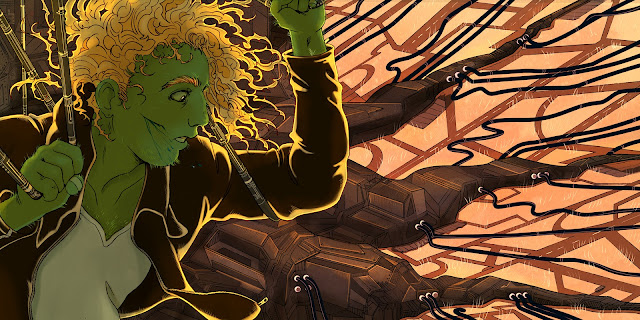
My story Sunless is currently in the free-to-read tier at IZ Digital.‘Tomey,’ the woman said again. She caught his arm and he let her rush him into a backroom.
‘How do you know my name?’ he said, checking his clothes. It surprised him to see so much blood, and not all of it the thick, dark blood of humankind.
‘It’s not a secret,’ she said.
She was a Kuru. Horns resembling those of a ram, eight of them, curled tightly over her skull like a helmet. She had ten eyes, eight black in two groups of four and two larger, more human eyes beneath.
Illustration by Juliana Pinho.
Peter Green Documentary and forthcoming story
I recently sold a story dedicated to Paul Kossoff, the guitarist with the band Free who was felled in his twenties by drugs. The rumor is that Koss had been clean for some time when a fan handed him something without warning. He died of a heart attack a short time later. Since I'm an SF writer, my story doesn't foreground drugs, picking a more contemporary way of Going Down Slow. I can't say more about where it'll appear yet, but stay tuned.
In the meantime, here's a documentary on Peter Green, a similarly astonishing blues guitarist with a depressingly familiar trajectory. In Green's case, he was introduced to LSD early on and appeared to weather that, but was somehow, mysteriously, taken in by some German "aristocrats" or "rich people" who plied him with LSD. In the documentary, at around the hour mark, you'll hear the band discuss how strange this was and how he immediately became seriously mentally ill (schizophrenia). Green, who was still alive at the time and appeared in the doco, doesn't appear to see it that way at all and the disconnect is quite startling. Who were these peculiar Germans - a cult? a religion? - and why did they meet Green at the airport as if by appointment?
We may never know, and I certainly shan't, because I can't tell what everyone is saying. I've lost the ability to understand English accents. :(
Anyway, "The Burn Out," about a teen fan who meets her boy-band idol and gives him a gift, is coming soon to a book store near you.
Tuesday, May 09, 2023
Artificial Intelligence: Threat or Menace?
I've read a number of articles like the one in today's Guardian and I have to say I'm not too happy about so-called "AI" myself. It draws some pretty pictures and can write a kids' story in 2 seconds, but on the downside it can produce bullshit in such incredible volumes that a lot of people are going to drown in it.
Deep learning pioneer Geoffrey Hinton announced on Monday that he was stepping down from his role as a Google AI researcher after a decade with the company. He says he wants to speak freely as he grows increasingly worried about the potential harms of artificial intelligence.
It's interesting to compare the gung-ho attitude of the gigantic silicon valley companies on this matter with that of the scientists who developed genetic engineering in the seventies. After the first few tentative steps, scientists quickly demanded a moratorium, held a symposium to discuss the issues and developed a safety system - within a few months. It's certainly possible to argue that the scientists got it wrong or didn't do enough but at the least they didn't shrug and say, "Aw fuck it, it might be okay," and just carry on with it.
I wrote about that moratorium in 1979 and you can read a transcript here on the blog.
Monday, April 10, 2023
Recent Review Roundup
Reviews of my recent stories include:
Tangent Online's Victoria Silverwolf reviewing Aurealis #157, February 2023
Set in India in the near future, “Autonomous” by Lyle Hopwood features a young man employed by a call center. He works his way up from collecting overdue bills to taking remote control of automated cars when their artificial intelligences cannot deal with unusual situations. Along the way, he becomes bitter and cynical. [...]
It powerfully demonstrates how the multinational nature of [call center] work causes [workers] to lose their native culture. The speculative technology in the story is highly plausible, and also serves as an effective metaphor for how the protagonist feels he is losing control of his life.
SF Revu reviewing Interzone 290-291-Double Issue, 26 June 2021
"Pace Car" by Lyle HopwoodWhen Alisa was three years old, Gates came down from the sky all over Earth. You could step through one and be transported to another part of Earth. But they would only transport organic matter. They transmitted fields for miles around that disintegrated inorganic matter. The resultant chaos had reduced the population of the Earth by five and a half billion people. [...]
Finely written bittersweet tale.
Sunday, April 09, 2023
Short story announcement: Lokitoo in the anthology Union by Dragon Soul Press
“How can you regard them with such equanimity, sister? Soldiers who fired on civilians?”
“They quelled a riot. They ended the looting.”
“But what kind of commander fires on a crowd from orbit? There were police on the ground. That was a demonstration of force, pure and simple.”
“If that is true, it didn’t work, because I am not afraid, and you are defiant. The clique who orders these things knows the emperor protects his citizens. It won’t happen again.”
He rubbed his chin, unwilling to argue with me. “It won’t. No one will forget the day the Intercalary Destroyer Sentry fired on its own people."
A Lyle Hopwood romance tale is now available in the excellent Dragon Soul Press anthology Union. This link can be used to order ebooks or paperbacks at Amazon and elsewhere.
In this science fiction anthology, love has no limits across space and time. From Artificial Intelligence, aliens, and intergalactic royalty. From headstrong characters fighting the status quo to those struggling to keep afloat in a tumultuous world. One way or another, their love will survive.
Featuring stories by Frank Sawielijew, Kevin A. Davis, Wris Kaye, David W. Landrum, E.B. Hunter, Lyle Hopwood, Amanda Barrett, Katie Kent, T.C. Mill, and Barend Nieuwstraten III.
Graphic sexual content is included within this anthology.
Saturday, March 11, 2023
Panhe Gathering and Celebration April 2nd, 2023
Panhe 2023 will be held on April 2nd.
San Mateo Campground, San Onofre State Beach, San Clemente.
Park at Concordia School -- there's a shuttle bus running all day.
Friday, February 24, 2023
Dublin 2019 World Science Fiction Convention Day 1
I'm at Dublin 2019 for the Worldcon, which means I traveled from Orange County, CA, USA to Dublin, Ireland.
I forgot to take a picture of OC before I left, but it's just going into fire season and basically looks like this:

In Dublin it's raining and looks more like this:

That's the famous Samuel Beckett harp-shaped bridge over the Liffey

This is the convention center, next to the bridge.
After a snooze we went for a walk in Dublin to get our bearings.

Above: Iguana Mural in the city center

Above: There's a LOT of construction around in the docklands, but the city center still looks mostly like this.

They have a street named for Rory Gallagher - well, a corner, which I can approve of. This appears to be in the designated Rock area, so I'll come back here later.

Temple Bar Inn. I failed to get a good picture of it. This area is basically Dublin's Soho, but we were there at like 7 am, so the swaying crowd of tourists is not present.

Above: Temple Bar Inn from the side
On the walk, we went for a Full Irish Breakfast at the Bittersweet coffee bar. It was very moreish and much like a Full English Breakfast except it had White Pudding as well as Black Pudding. White Pudding is (as far as I can tell) just pale Black Pudding. The Black Pudding isn't as spicy and salty as it is in Yorkshire, but it's tasty. I was glad to have it again after all these years.
We walked back to the convention center for our first panel discussion. (We got our steps in on this trip, but given the size of the breakfasts and breakfast pastries, there was no chance of losing weight.)
Retro Hugos Discussion
Robert Silverberg, the dapper and long-winded "only living recipient of a retro Hugo", Jo Walton, Heidi Lyshol and Jukka Sarkijarvi.
Biggest issue seemed to be - what are we voting *as*? As a person in 1944 would vote, or as we would have voted on the first day we read these old stories, or as a 2019 person assessing these stories from a modern perspective? The upshot seemed to be that Silverberg thought these stories would not have been popular in 1944, and Sarkijarvi seemed to think these stories shouldn't be popular in 2019 (problematic) so we would probably go with Jo Walton, who thought these stories would have been popular when we were 12 (the Golden Age of SF).
I did think Silverberg and Sarkijarvi were going to come to blows over whether "an armed society is a free society" would have been an acceptable slogan to a Finn in 1944.
Actual winners (announced that evening)
Best Novel
Conjure Wife, by Fritz Leiber, Jr. (Unknown Worlds, April 1943)
Best Novella
The Little Prince, by Antoine de Saint-Exupéry (Reynal & Hitchcock)
Best Novelette
“Mimsy Were the Borogroves,” by Lewis Padgett (C.L. Moore & Henry Kuttner) (Astounding Science-Fiction, February 1943)
Best Fanzine
Le Zombie, editor Wilson “Bob” Tucker
Best Fan Writer
Forrest J Ackerman
Invasion and the Irish Imagination
Ruth Frances Long | Jo Zebedee | Ian McDonald | Dr Jack Fennell | Peadar Ó GuilÃn
I thought this might be a victim-fest with various people vying for the title of most invaded victim in history, but it turned out to be very interesting and without a touch of identitarianism. In fact the book referred to in the programme, the Book of Invasions (Lebor Gabala Erenn) is the story of the *Irish* invading Ireland and making it theirs - as one panelist put it, pushing the Sidhe, the previous mysterious inhabitants, out to the fringes, from where they've been raiding ever since. The others mentioned in the programme - the Normans and the English - just got shrugs. It seems everyone is welcome over time, assimilates and joins in. One panelist pointed out that the Statutes of Kilkenny were written to prevent the Normans from being assimilated into Irish life, but they had to be translated into Irish, because the Norman/English no longer spoke any other language.
We had lunch at a Sushi place called Musashi which was okay.
Liking Problematic Things
Sarah Gulde | Leo Adams | A. T. Greenblatt | Sam Hawke
Short answers seem to be:
1. Don't like problematic things
2. Tell your friends not to like problematic things, but break it to them gently because they might mourn the loss of whatever artist/artwork and be bummed.
I can't say I agree, but I do realize that at least some of the panelists felt that certain artists were trying to erase their (the panelist's) existence, which is obviously painful, or portraying their identity badly or incorrectly, which I can see could be an issue.
AI and the Myth of Singularity
Klaus Æ. Mogensen (Copenhagen Institute for Futures Studies) | Lettie Prell | Hadas Sloin | Martha Wells
This was mildly interesting but the audience seemed to already know as much as the panelists, which meant it resembled a sort of live-action twitter thread. The Paperclip Maximizer got a lot of exercise.
How to Manage Finite Natural Resources
Vincent Docherty | Sazib Bhuiyan (Can With Candle) | Nigel Quinlan | Annalee Newitz | Cliona Shakespeare
Another live-action Twitter thread, though I thought Annalee Newitz could have done a Cory Doctorow and brought major knowledge and erudition to the thread if she's been afforded more time.
Dinner was Chinese was take-out from the local take-away, which was delectable. Duck, prawn crackers, sesame toast, lightly gingered chicken, not too sweet. It's a hole in the wall called Starry Night and I recommend it.
Friday August 16th
Can't remember a thing about this.
Nope, not a damn thing.
Hammer people are always funny and well-informed, so this was a lot of fun. Can't remember any specifics, but it seems the intersection of Hammer and Nigel Kneale is the motherlode.
Spirited discussion of Big Data and what it could be used for. I'd say "no" for the programme's question, but the movement of crowds is definitely understood,
What it says on the tin.
Wonderfully uplifting presentation by Dr Epps on how she studied and trained to be an astronaut. Not much use to me - I'd fail at several points - but I hope people younger than me get a chance to hear her and follow in her footsteps.
Can't remember a damn thing about it, but enjoyed everyone's contribution.
Eugene was literally the first person (except from NASA) who knew what a screen was for and had slides. Funny and informative presentation.
Archaeologists are a lively and well-informed bunch, so this was informative.
Today's politics are horrible and we hate the other, so blah blah blah
Thursday, February 23, 2023
My short story "Autonomous" published in Aurealis magazine #157
I am very pleased to announce my new story Autonomous is published in the latest edition of Aurealis magazine, #157. And a superb edition it is too - great stories, beautifully illustrated and wrapped in a nice cover.
"Autonomous" tells the story of a man working at the user support call-center for a brand of self-driving cars. If a vehicle fails to sense road conditions adequately, it notifies the help center and a support tech takes manual control until the vehicle is back within specifications. The job entails long hours on the night shift, short periods of white-knuckle anxiety interspersed with time to think about things. Too much thinking leads him to a revelation about his place in society.
Excerpt from the beginning of "Autonomous":
It wasn’t immediately apparent why the autonomous vehicle notified Surya that it wanted to hand over control to a human. Surya, sitting in his cubicle in the Faraday data centre, struggled with the camera views before he realized the person in the driver’s seat must be incapacitated. Surya could tell they had slumped over from the way there was no head between the rear-view mirror and the car’s internal camera. Drunk, asleep, giving head… It wasn’t his place to figure out why. His task was to get the vehicle to safety.
ChatGPT on the Moon, with shark adrenaline
I wasn't particularly excited by the rise of AI text generators until February 20th, when Neil Clarke had to close Clarkesworld (a major SF short story market) to new submissions in order to fight off a sudden flood of computer-written short stories.
![]() |
| Input: Please write a short fiction story (about 500 words) in which the Superbowl Left Shark becomes the first marine dancer on Earth's Moon. |
"Please write a short fiction story (about 500 words) in which the Superbowl Left Shark becomes the first marine dancer on Earth's Moon.""Left Shark had always been a talented dancer. He had spent years perfecting his moves, and his performance at the Superbowl had made him famous around the world. But even as he basked in the glory of his newfound celebrity, Left Shark knew that he was destined for something more.One day, as he was watching the moon rise over the ocean, an idea occurred to him. What if he could dance on the moon? It was a crazy idea, but Left Shark was determined to make it happen.He spent months training in a specially-designed underwater tank, perfecting his moves and building up his strength. Finally, he felt ready to take on the challenge of dancing in space.The day of the launch arrived, and Left Shark climbed aboard the spacecraft that would take him to the moon. As he blasted off into the sky, he felt a thrill of excitement and anticipation. This was his chance to do something no one had ever done before.When he landed on the moon, Left Shark stepped out of the spacecraft in his specially-designed spacesuit. He could feel the difference in gravity immediately – it was like dancing in slow motion. But he was undaunted. He had practiced for this moment, and he was ready to show the world what he could do.As he began to dance, Left Shark felt a rush of adrenaline. The lunar landscape stretched out before him, a barren expanse of rock and dust. But as he moved, he created something beautiful – a dance that was both powerful and graceful, a celebration of the human (or, in his case, shark) spirit.As he danced, Left Shark felt a sense of freedom that he had never experienced before. For the first time in his life, he was truly weightless, unencumbered by the limits of gravity. It was like he was flying, soaring through the void of space.And then, as suddenly as it had begun, the dance was over. Left Shark returned to Earth, hailed as a hero and a trailblazer. But he knew that his journey was far from over. There were other planets to explore, other dances to be danced.Years later, as he looked back on his life, Left Shark knew that he had achieved something truly remarkable. He had gone where no dancer had gone before, and he had shown the world what was possible when you dared to dream."
Friday, November 11, 2022
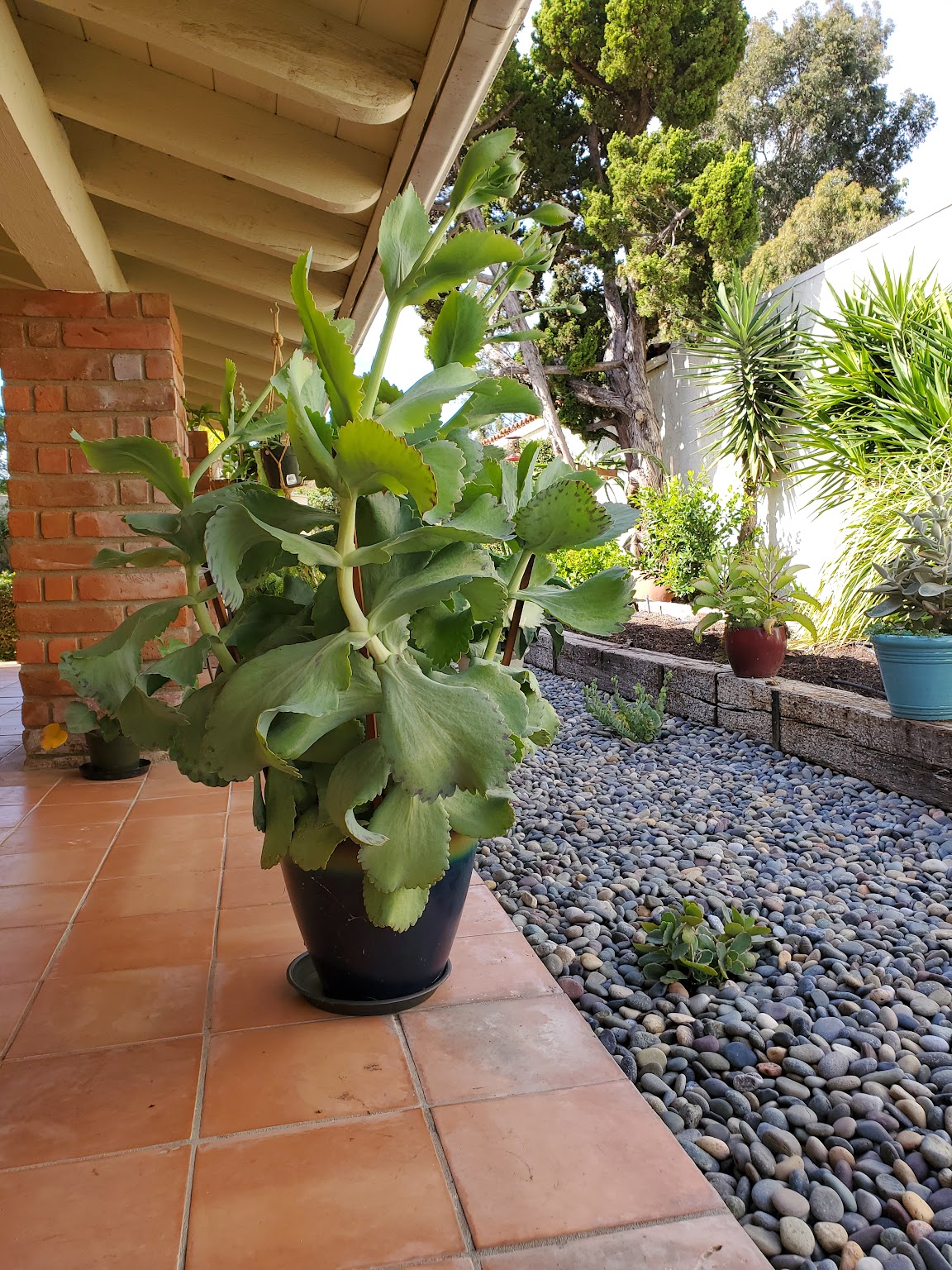
Kalanchoe collection: K. marmorata flowering
When we last saw this little fellow, Kalanchoe marmorata, back in May, he was a big, fleshy bedding plant with presence but not that Kalanchoe oomph.
Guess what. It's flowering season, and he's showing normal Kalanchoe behavior.
Monday, October 31, 2022
Bonfire Night (short story)
![]() |
| Bonfire image created with https://creator.nightcafe.studio/ |
My writing class prompt this week was to write about Halloween. I did a Halloween story last year and I didn’t want to write about Halloween this year. We didn’t celebrate it growing up (although it’s taken off in the UK now). Our celebration was called Bonfire Night, November the 5th. People nowadays light bonfires in memory of Guy Fawkes, who tried to blow up the Houses of Parliament in 1605. A human effigy, called a Guy, is placed on top of the bonfire. However, the tradition dates back to the Celtic feast of Samhain, when the veil between the spirit world and our world is thin.
Note: A Recce is a recreation area [play area for kids]. An
allotment is a personal garden that is not attached to a house.
#
“Penny for the Guy,” Mark says hopefully.
The shopper turns and stares at the boys sitting on the flagstones
in front of Woolworths. “Call that a Guy? It’s just trousers and a cardigan sewn
on a pillow.”
“Ain’t got no money,” Andy explains. Andy’s body has begun
the process of growing up. At eleven he’s almost a foot taller than the two
ten-year-olds beside him.
“If you buy a Guy Fawkes mask for it, I’ll give you fifty
pee.”
“Wor, fanks,” Andy says, catching the heavy coin.
“Bonfire night’s tonight,” she says. “Get a shift on.”
When she’s out of earshot, Andy says to Sid, “Nick a mask
from Woolies. Save us a bob or two we can spend on fireworks.”
“I’m not nicking noffink,” Sid says. “Buy a mask, and me
sister will sew a pillow for the head and put the mask on it and we’ll be
laughin’.”
“He’ll burn good and proper,” Mark says.
“We need more wood for the bonfire,” Sid says. “I know an
empty house with wooden floors.”
*
The bonfire is behind Mark’s house, in a Recce near the
allotments. There’s nothing nearby
except clumps of Fireweed that sprang up after last year’s celebration. Sid’s
mum has a shed in her allotment, and that’s where they keep the fireworks.
As Mark arrives with the last armful of floorboards, Sid and
Andy are arguing. Sid’s refusing to put his new-found floorboards against the
half-built cone.
“Me Dad said you shouldn’t actually build the bonfire until
day of,” Sid was explaining. “We have to move it and pile the wood up again.”
“It’ll take too long,” Andy replies.
“Day of. Or it’s bad luck or sa’ink, I dunno. But me dad said…”
“Your dad’s dead,” Mark says.
Instantly, Sid’s eyes redden. “What’s that got to do wiv it?
Being dead don’t make you wrong.”
Seeing the smaller kid about to cry, Andy switches sides. “Come
on, Mark. Maybe Sid’s dad has a point.”
“Had,” Mark says, sotto voce. Sid doesn’t notice.
“How far are we moving it?” Andy says.
“He just said ‘build it on the 5th, not before,’”
Sid says.
“Move it…what…six feet toward the house. That way we can use
a pallet as the new base.”
Andy drops a wood pallet in the new spot. The kids grab the
wood and start building a new cone.
“Fuckin’ ‘ell,” Sid suddenly shouts. “I caught me hand on a
nail.”
“You should wear gloves,” Andy says from his lofty height.
Sid feels between the two planks. “It’s not a nail.” He
reaches into the dark interior of the woodpile. Rolls something out.
“It’s a hedgehog,” Mark says.
“I can see that,” Sid says.
“It’s all in a spiked ball, like in a kid’s book.”
“I can see that,” Sid says.
“You have to take it home and feed it milk and bread,” Andy
says.
“Why? I don’t think mummy and daddy hedgehog fed it milk and
bread,” says Sid.
“Hedgehogs are mammals,” Mark says, knowledgeably. “They eat
milk.”
“I’ll put it in a cardboard box in the shed,” Sid says.
“Until the fires are all out and the smoke’s gone.”
“That’s what your dead dad meant, innit,” Mark says. “He meant don’t burn wood until you know what’s under it.”
Sid nods and resumes stacking floorboards on the new pile.
It’s getting dark. In two hours, Sid’s sister will bring out the Parkin and Bonfire Toffee. His Mum will open the box of fireworks and hand out sparklers to the little ones.
#
Sunday, October 30, 2022
The House on the Hill Opposite is in Spooky Mode today
Tuesday, October 18, 2022
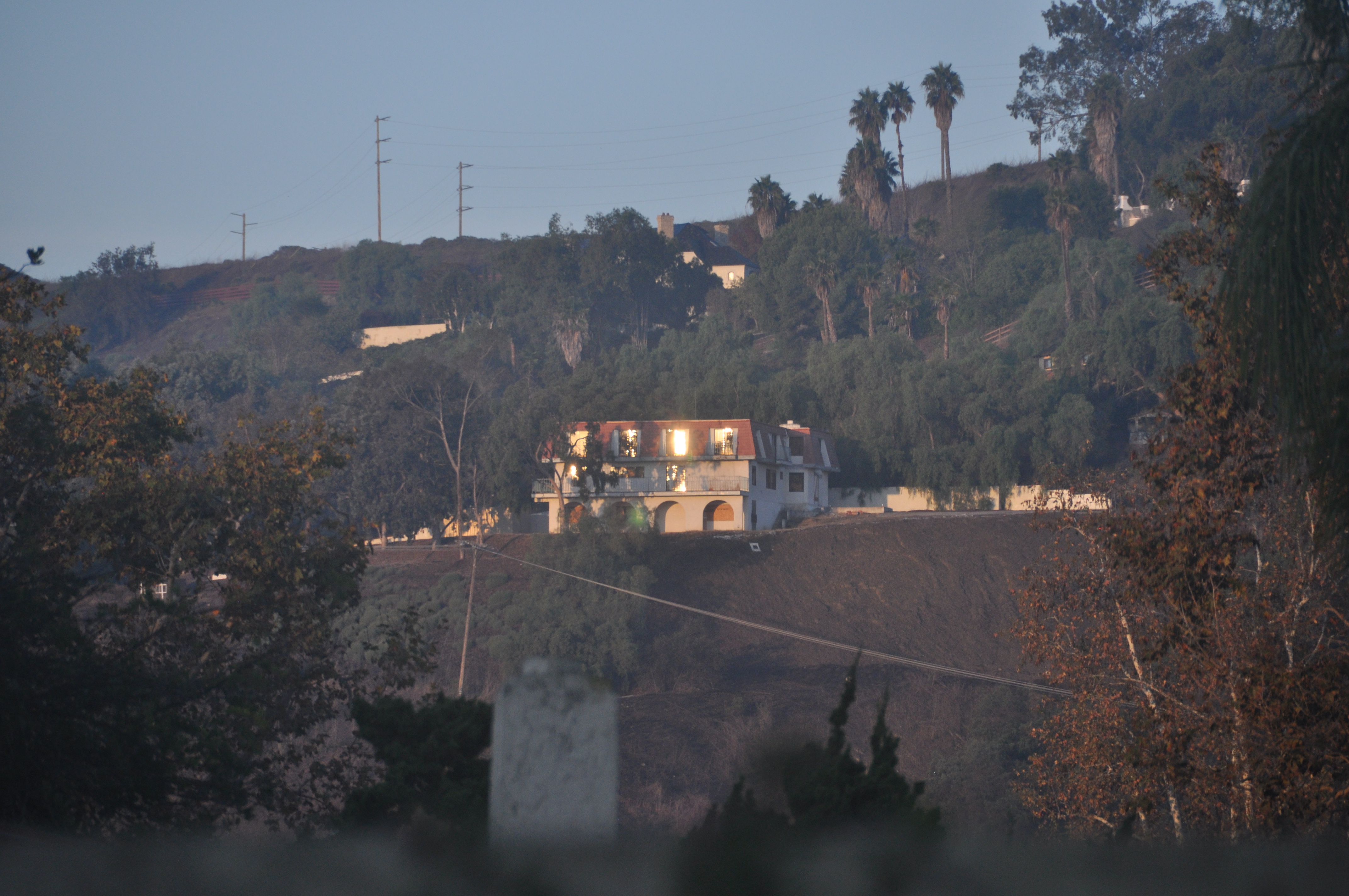
The House on the Hill Opposite That Lights Up at Dawn
I normally feature The House on the Hill Opposite That Lights Up at Dawn during February, when it lights up at dawn to presage the coming of spring.
Of course, it also lights up at dawn just before fall starts in earnest, in mid-October. Many Ides of October are overcast here in So Cal and so the viewing isn't as good. It's been misty in the early morning for weeks, and just recently it rained for a solid day. (It started approximately an hour after I finished planting our mandatory drought-resistant plants, which replaced our lawn. Good luck with avoiding root rot, my little Kalanchoe friends!)
But it cleared up on Monday, so today and yesterday were the days The House on the Hill Opposite That Lights Up at Dawn to presage the coming of Autumn.
| HOTLUAD |
| HOTLUAD |
You can see from the telephoto shot that the debris around the house, the number of broken windows and the slope erosion are all getting worse. The upper floor is still poised to Light Up at Dawn, though and the last time we visited the property, it looked like the slab was in good condition. May it continue to presage the autumn. (And spring.)
![]() |
| HOTLUAD Today |